Pregnancy apps can make it easier to keep track of your pregnancy, learn about upcoming milestones, organize information, and build healthy daily routines.
But with so many pregnancy and wellness apps available, choosing the right one can be surprisingly difficult.
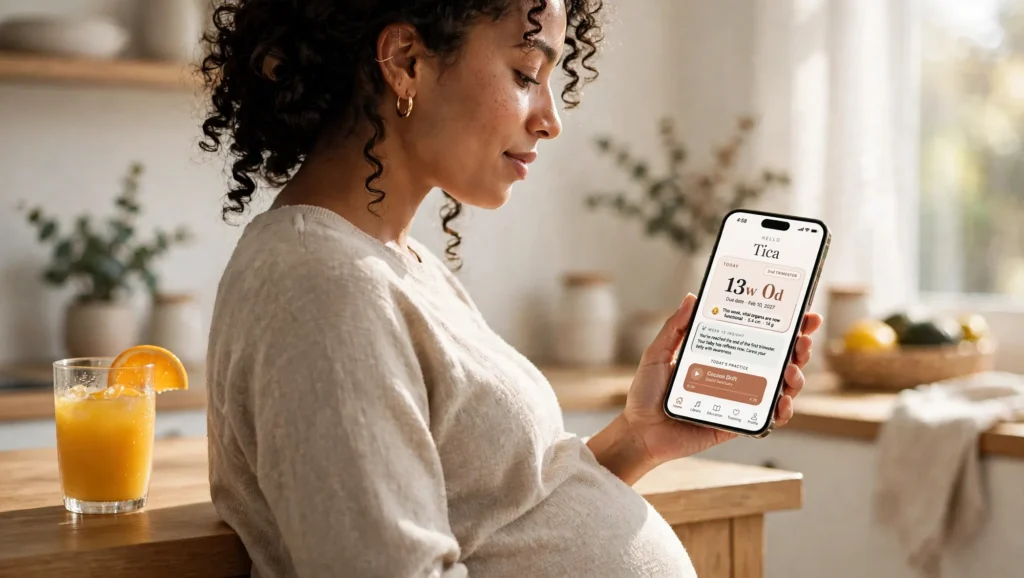
Some apps focus mainly on pregnancy tracking. Others provide educational resources, wellness activities, nutrition information, appointment reminders, journaling, relaxation tools, or audio experiences. Some combine several of these features into one pregnancy companion.
The best pregnancy wellness app is not necessarily the one with the longest feature list.
It is the one that provides useful, trustworthy features that match your needs while respecting your privacy and making your pregnancy experience easier rather than more overwhelming.
This guide explains what to look for when choosing a pregnancy wellness app and how to evaluate one before making it part of your pregnancy routine.
What Is a Pregnancy Wellness App?
A pregnancy wellness app is a mobile application designed to support different aspects of pregnancy wellbeing.
Depending on the app, it may offer:
- Pregnancy tracking
- Week-by-week information
- Pregnancy milestones
- Educational resources
- Self-care tools
- Relaxation exercises
- Mindfulness activities
- Journaling
- Prenatal bonding activities
- Music or audio
- Nutrition information
- Exercise guidance
- Appointment reminders
- Postpartum preparation
- Community or support features
Not every app offers all of these features.
That is why it is useful to identify what you actually want from an app before downloading one.
Why Does Choosing the Right Pregnancy App Matter?
A pregnancy app may become something you use frequently throughout your pregnancy.
You may enter personal information, read health-related content, track symptoms, record milestones, or use the app as part of your daily routine.
That makes several factors important.
A good pregnancy wellness app should ideally be:
- Relevant to your needs
- Easy to use
- Transparent about its information
- Respectful of your privacy
- Clear about its limitations
- Helpful without creating unnecessary anxiety
- Updated and maintained
- Designed around a positive user experience
The goal is to find a tool that supports your pregnancy rather than turning pregnancy into another set of numbers and notifications to manage.
1. Start by Identifying What You Want From the App
Before comparing pregnancy apps, ask yourself:
What do I actually need help with?
Your answer might be:
- Tracking pregnancy weeks
- Learning about pregnancy milestones
- Managing daily wellness
- Finding relaxation activities
- Practicing mindfulness
- Listening to calming music
- Journaling
- Preparing for postpartum life
- Organizing appointments
- Finding reliable educational information
- Creating prenatal bonding routines
You may want several of these features.
Knowing your priorities makes it easier to distinguish between apps that look impressive and apps that are genuinely useful to you.
2. Look at the App’s Main Purpose
Not every pregnancy app is designed to do the same thing.
For example, one app may primarily be a pregnancy tracker, while another may focus on meditation or wellness.
Another may concentrate on educational content.
Another may be built around audio and relaxation.
Before downloading an app, look at its main purpose.
Ask:
What problem is this app actually designed to solve?
If you want a pregnancy wellness companion but download an app focused almost entirely on tracking, you may eventually find that it does not meet your needs.
3. Look for Useful Pregnancy Tracking Features
If pregnancy tracking is important to you, look for features that make tracking simple rather than complicated.
Useful features may include:
- Pregnancy week tracking
- Due-date information
- Trimester information
- Pregnancy milestones
- Appointment organization
- Personal notes
- Pregnancy journal features
- Important reminders
Tracking should help you understand your pregnancy journey.
It should not encourage unnecessary comparison with other pregnancies.
Every pregnancy is individual, and an app should not make you feel as though your pregnancy must follow an exact digital timeline.
4. Evaluate the Quality of Pregnancy Information
This is one of the most important considerations.
Pregnancy apps may provide health and educational information, so you should pay attention to where that information comes from.
Look for:
- Clearly identified sources
- Medical or professional review where appropriate
- Evidence-informed explanations
- Transparent authorship
- Updated content
- Clear distinctions between education and medical advice
Be cautious when an app makes dramatic claims without explaining the evidence behind them.
An attractive interface cannot compensate for unreliable health information.
5. Check Who Creates or Reviews the Content
Ask:
Who is responsible for the pregnancy information inside the app?
Some apps identify doctors, midwives, nutrition professionals, psychologists, or other qualified contributors.
That does not automatically mean every statement is correct, but transparency about authorship and review is a useful sign.
You should also be able to distinguish between:
- Educational content
- User-generated content
- Marketing claims
- Professional guidance
- Personalized medical advice
A responsible health app should not make you believe that general educational information is a substitute for your healthcare provider.
6. Look for Clear Medical Limitations
A pregnancy wellness app should understand the difference between supporting someone and providing medical care.
Be cautious if an app suggests that it can:
- Diagnose pregnancy complications
- Replace your doctor
- Guarantee a particular health outcome
- Treat serious medical conditions without professional involvement
- Tell you with certainty whether a symptom is safe
A useful pregnancy app should encourage you to seek professional advice when something requires medical evaluation.
7. Consider Privacy Before Entering Personal Information
Pregnancy information can be highly sensitive.
Depending on the app, you may enter information about:
- Pregnancy dates
- Health history
- Symptoms
- Medications
- Location
- Lifestyle
- Mood
- Fertility
- Baby-related information
Before using an app extensively, review its privacy information.
The FTC advises consumers to compare privacy protections, understand what health information an app collects and how it is used or shared, and review privacy settings.
Ask:
- What information does the app collect?
- Why does it need that information?
- Is the information shared with third parties?
- Is it used for advertising?
- Can you control certain permissions?
- Can you delete your account or data?
- Does the company clearly explain its practices?
Do not assume that a health-related app automatically has the same privacy protections as your healthcare provider.
8. Check App Permissions
When installing an app, look at the permissions it requests.
Does a pregnancy wellness app really need access to:
- Your location?
- Your contacts?
- Your microphone?
- Your photos?
- Your health data?
- Your Bluetooth devices?
Some permissions may be necessary for specific features.
Others may not be.
The FTC recommends minimizing data collection and limiting access and permissions to what is necessary for an app’s functions.
If an app requests access that seems unrelated to what you want it to do, consider whether you are comfortable granting that access.
9. Look for Privacy Controls
A strong privacy experience should give users meaningful choices.
For example, you may want the ability to:
- Adjust permissions
- Disable optional data collection
- Control notifications
- Control location access
- Manage account information
- Delete personal information where applicable
Privacy settings should be understandable rather than buried behind complicated language.
Remember that privacy is not only about having a privacy policy.
It is also about how much control you have over your information.
10. Consider Whether the App Uses Advertising
Some pregnancy apps are free because they generate revenue through advertising, partnerships, subscriptions, or other business models.
Advertising is not automatically a reason to reject an app.
However, you should understand whether advertising affects your experience or involves the use of personal information.
Pay particular attention when an app combines highly sensitive health information with advertising or third-party data sharing.
The FTC has previously taken action involving pregnancy and fertility apps over the handling and sharing of sensitive health information.
This is a good reminder to read privacy information before assuming your pregnancy data will remain private.
11. Look for Personalization Without Unnecessary Complexity
Personalization can make a pregnancy app more useful.
For example, an app may adapt content based on:
- Pregnancy stage
- Due date
- Preferences
- Wellness goals
- Listening preferences
- Interests
But personalization should make the experience easier.
You should not have to complete a long questionnaire just to access basic information.
Look for apps that give you useful personalization while allowing you to control what information you provide.
12. Evaluate the App’s Wellness Features
If your main reason for downloading a pregnancy app is wellness, look beyond basic pregnancy tracking.
Useful wellness features might include:
- Relaxation exercises
- Mindfulness
- Breathing activities
- Journaling
- Sleep routines
- Gentle movement guidance
- Stress-management resources
- Positive reflection
- Prenatal bonding activities
The best features are often those you can realistically incorporate into everyday life.
13. Consider Audio and Music Features
For some expectant mothers, audio can be an important part of pregnancy wellness.
You might look for:
- Calming music
- Instrumental tracks
- Relaxation audio
- Mindfulness audio
- Guided breathing
- Nature sounds
- Prenatal bonding audio
If music is important to you, consider whether the app treats audio as a meaningful part of the pregnancy experience or simply includes a small playlist as an extra feature.
For more information about pregnancy music, see our guide to pregnancy music and its uses during pregnancy.
14. Look for Features That Support Prenatal Bonding
Pregnancy wellness is not only about tracking physical changes.
You may also want opportunities to create emotional moments of connection with your baby.
Features might include:
- Prenatal bonding activities
- Talking or singing prompts
- Music
- Journaling
- Reflection exercises
- Pregnancy milestone memories
- Partner activities
There is no single correct way to bond with your baby.
A useful app should provide opportunities without making you feel pressured to complete a specific bonding routine.
15. Check Whether the App Includes Educational Resources
A pregnancy wellness app can be particularly useful when it helps you understand your pregnancy.
Educational sections might cover:
- Pregnancy milestones
- Trimester changes
- Prenatal appointments
- Common pregnancy questions
- Wellness
- Nutrition
- Birth preparation
- Postpartum preparation
Look for information that is clear, appropriately sourced, and careful about the difference between general education and individualized medical advice.
16. Think About Your Pregnancy Stage
The best app for someone in early pregnancy may not be the best app for someone preparing for birth.
Your needs can change.
Early Pregnancy
You may prioritize:
- Pregnancy tracking
- Early pregnancy education
- Appointment information
- Wellness basics
- Emotional support
Middle Pregnancy
You may become more interested in:
- Pregnancy milestones
- Prenatal bonding
- Movement
- Relaxation
- Baby preparation
Late Pregnancy
You may prioritize:
- Birth preparation
- Postpartum planning
- Hospital preparation
- Relaxation
- Sleep
- Final pregnancy milestones
Choose an app that can remain useful as your needs change.
17. Consider the User Experience
Even an excellent set of features becomes frustrating if the app is difficult to use.
Look for:
- Simple navigation
- Clear menus
- Readable text
- Fast loading
- Logical organization
- Accessible controls
- Minimal unnecessary notifications
Ask yourself:
Can I find what I need quickly?
A pregnancy app should reduce friction rather than create more of it.
18. Pay Attention to Notifications
Notifications can be useful.
They can remind you about:
- Appointments
- Pregnancy milestones
- Daily wellness activities
- Journaling
- Hydration
- Other routines
But too many notifications can become stressful.
Look for an app that allows you to customize or disable unnecessary notifications.
Your pregnancy app should work around your life, not constantly demand your attention.
19. Read Recent Reviews Carefully
App-store reviews can help you identify recurring usability problems.
Look for patterns rather than focusing on one extremely positive or negative review.
Pay attention to comments about:
- Bugs
- Crashes
- Subscription problems
- Privacy concerns
- Difficult navigation
- Excessive advertisements
- Missing features
- Customer support
- Data loss
Remember that reviews are personal experiences, not medical evidence.
A large number of positive reviews does not automatically mean that an app provides medically reliable information.
20. Check How Frequently the App Is Updated
An app that handles health or pregnancy information should be maintained responsibly.
Look at:
- Recent update activity
- Bug fixes
- Feature improvements
- Developer responses
- Customer support
Frequent updates do not guarantee quality, but an abandoned app may be less useful over time.
21. Compare Free and Paid Features
Many pregnancy wellness apps use subscriptions or premium features.
Before subscribing, understand exactly what you are paying for.
Ask:
- What features are free?
- What requires payment?
- Is there a trial?
- How much does the subscription cost?
- Does the subscription renew automatically?
- Can you cancel easily?
- Are essential features locked behind a subscription?
A more expensive app is not necessarily better.
Choose based on usefulness rather than the number of premium features.
22. Think About Whether You Want an All-in-One App
Some people prefer one app that combines multiple functions.
An all-in-one pregnancy companion might include:
- Tracking
- Education
- Wellness
- Audio
- Journaling
- Milestones
- Prenatal bonding
- Postpartum preparation
This can be convenient because you do not have to switch between several apps.
However, another person may prefer specialized apps that do one thing particularly well.
The right choice depends on your preferences.
23. Choose an App That Supports Rather Than Replaces Your Healthcare Team
This is one of the most important principles.
A pregnancy app can help you:
- Learn
- Organize
- Track
- Reflect
- Relax
- Prepare questions
But it cannot replace your prenatal healthcare team.
If you experience concerning symptoms or have questions about your individual health, contact your healthcare provider.
A responsible pregnancy app should make this distinction clear.
24. Consider Whether the App Creates Anxiety
This is an often-overlooked part of choosing a pregnancy wellness app.
An app can technically provide useful information while still making you feel overwhelmed.
Consider how you feel after using it.
Does it make you:
- Feel informed?
- Feel supported?
- Feel organized?
- Feel calmer?
Or does it make you:
- Constantly compare your pregnancy?
- Worry about every symptom?
- Obsess over numbers?
- Feel guilty about missed activities?
- Receive too many alerts?
If an app consistently increases your anxiety, it may not be the right wellness tool for you.
25. Look for Flexible Wellness Features
Pregnancy does not feel the same every day.
A good wellness app should allow flexibility.
One day you may want:
- A relaxation session
Another day:
- Pregnancy education
Another:
- Music
Another:
- Tracking
Another:
- Nothing at all
Wellness should adapt to your needs rather than becoming another obligation.
26. Consider Womb Serenade as an Example of a Pregnancy Wellness Companion
Womb Serenade takes a broader approach to pregnancy support by combining audio-focused experiences with pregnancy tracking, milestones, health education, and wellness-oriented features.
For expectant mothers who want more than a traditional pregnancy tracker, this type of pregnancy companion can provide several activities within one environment.
For example, you can use a pregnancy companion like Womb Serenade to create moments around:
- Pregnancy music
- Relaxation
- Mindfulness
- Prenatal bonding
- Pregnancy milestones
- Pregnancy education
- Reflection
- Daily wellness
The important consideration is not simply whether an app has many features.
It is whether those features are useful, easy to use, trustworthy, and relevant to your pregnancy journey.
Womb Serenade is designed to complement pregnancy wellness and prenatal care rather than replace medical advice or professional healthcare.
27. Use a Pregnancy App Evaluation Checklist
Before committing to an app, ask yourself these questions.
Purpose
- What is this app mainly designed to do?
- Does that match what I need?
Information
- Is the content clearly sourced?
- Are medical claims appropriately presented?
- Can I identify who creates or reviews the information?
Privacy
- What information does the app collect?
- How is it used?
- Is it shared?
- Can I control permissions?
Features
- Does it provide the features I actually need?
- Will those features remain useful throughout pregnancy?
Experience
- Is the app easy to navigate?
- Are notifications manageable?
- Does it feel supportive?
Cost
- What is free?
- What requires payment?
- Is the subscription worth it for me?
Healthcare
- Does the app clearly distinguish education from medical care?
- Does it encourage appropriate professional support?
Emotional Impact
- Does using the app make me feel informed and supported?
- Or does it increase my anxiety?
If an app performs well across these categories, it may be worth trying.
Pregnancy Wellness App Comparison Checklist
| Feature | What to Look For |
|---|---|
| Pregnancy tracking | Simple week and milestone tracking |
| Education | Clear, reliable, appropriately sourced information |
| Wellness | Relaxation, mindfulness, self-care |
| Audio | Music, calming audio, or guided activities |
| Prenatal bonding | Gentle connection and reflection activities |
| Privacy | Clear data collection and sharing policies |
| Permissions | Reasonable and controllable access |
| Personalization | Useful customization without excessive data collection |
| Notifications | Relevant and adjustable |
| Usability | Simple, accessible navigation |
| Updates | Ongoing maintenance |
| Cost | Transparent pricing and subscription terms |
| Healthcare boundaries | Clear distinction between app content and medical care |
| Emotional experience | Supportive rather than anxiety-inducing |
Common Mistakes When Choosing a Pregnancy Wellness App
Choosing the App With the Most Features
More features do not necessarily mean more value.
A simple app that you use consistently may be more useful than a complicated app that you rarely open.
Ignoring Privacy
Do not treat privacy as an afterthought.
Health-related information can be highly sensitive, so understand what an app collects and how it uses that information.
Trusting Every Health Claim
An app’s presence in an app store does not automatically make every health claim inside it reliable.
Check the source.
Choosing Based Only on Ratings
Ratings tell you about user experiences, not necessarily medical accuracy or privacy practices.
Paying Before Testing the Experience
If possible, explore the free features or trial period before committing to a subscription.
Using an App Instead of Asking Your Healthcare Provider
A pregnancy app can provide education and organization.
It cannot evaluate your individual health in the same way a healthcare professional can.
How to Get the Most From Your Pregnancy Wellness App
Once you choose an app, avoid trying to use every feature immediately.
Start with the functions that matter most.
For example:
Week 1:
Set up your pregnancy information.
Week 2:
Explore educational resources.
Week 3:
Try one wellness feature.
Week 4:
Add a simple journaling or reflection routine.
Ongoing:
Use only the features that genuinely improve your experience.
You can also review the app’s privacy settings after installation and periodically check whether anything has changed.
Frequently Asked Questions
What should I look for in a pregnancy wellness app?
Look for reliable educational content, useful pregnancy tracking, privacy controls, relevant wellness features, easy navigation, transparent pricing, reasonable permissions, and clear boundaries between app information and professional medical care.
Are pregnancy wellness apps safe to use?
Pregnancy apps can be useful tools, but their quality and privacy practices vary. Review the app’s information sources, permissions, privacy policy, and health claims before relying on it.
Should I choose a pregnancy tracker or a pregnancy wellness app?
It depends on your needs. A pregnancy tracker may be enough if you mainly want week-by-week information and milestones. A wellness app may be more appropriate if you also want relaxation, mindfulness, music, journaling, or other wellbeing features.
Are pregnancy apps private?
Privacy varies between apps. Do not assume that an app protects health information in the same way as your healthcare provider. Review what information the app collects, how it is used, and whether it is shared with third parties.
Do pregnancy apps replace prenatal care?
No. Pregnancy apps can support education, tracking, organization, and wellness, but they do not replace prenatal appointments or personalized medical advice.
Should I pay for a pregnancy wellness app?
Not necessarily. Compare the free and paid features and decide whether the additional features provide enough value for your needs.
What is the most important feature in a pregnancy app?
There is no single most important feature for everyone. Reliable information, appropriate privacy practices, usability, and features that genuinely match your needs are more important than simply having a long feature list.
Can a pregnancy wellness app help with relaxation?
Some apps include music, mindfulness, breathing exercises, meditation, or other relaxation features. These can become part of a personal wellness routine, although they should not be treated as a replacement for professional mental health care when needed.
Can Womb Serenade be used as a pregnancy wellness app?
Womb Serenade is designed as a broader pregnancy companion combining audio experiences with pregnancy tracking, milestones, health education, and wellness-oriented features. It can be used as part of a pregnancy wellness routine while continuing regular prenatal care.
Final Thoughts
Choosing a pregnancy wellness app is ultimately about finding the right balance between usefulness, trust, privacy, simplicity, and personal relevance.
Start by identifying what you actually want from an app.
Then look beyond the screenshots and feature list.
Check the quality of the information. Understand the privacy practices. Review permissions. Consider whether the app is easy to use. Look at the pricing. Pay attention to how the app makes you feel.
Most importantly, remember that a pregnancy app is a tool not your healthcare provider.
The best pregnancy wellness app should help you feel more informed, organized, supported, and connected throughout your pregnancy without creating unnecessary pressure.
Whether you choose a simple pregnancy tracker, a specialized wellness app, or a broader pregnancy companion such as Womb Serenade, choose the tool that fits your needs and supports the kind of pregnancy experience you want to create.