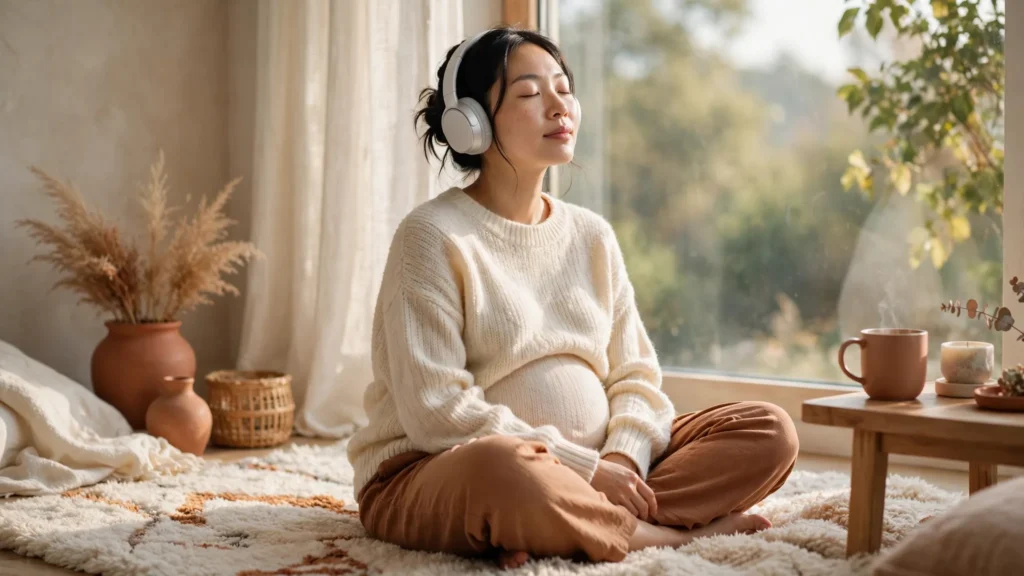
Pregnancy brings many questions about what your baby can experience before birth. One of the most interesting is sound.
When can a baby hear? Can your baby recognize your voice? Is listening to music during pregnancy safe? Should you put headphones on your belly? And how much should you worry about loud environments?
Understanding how hearing develops during pregnancy can help you make informed choices without turning everyday sounds into another source of anxiety.

Your baby’s hearing develops gradually during pregnancy. As development progresses, the fetus can respond to sounds, including sounds from inside and outside the body. At the same time, very loud or prolonged noise exposure deserves more attention than ordinary everyday listening.
This guide explains what expectant parents should know about fetal hearing, music during pregnancy, loud noise, headphones, talking to your baby, and creating a comfortable sound environment during pregnancy.
How Does Hearing Develop During Pregnancy?
Your baby’s ears and hearing system develop gradually rather than becoming fully functional at one particular moment.
According to ACOG, hearing begins developing during the second trimester, and by around 18 weeks, the fetus can hear sounds. Later in pregnancy, loud sounds can produce a movement response.
The CDC’s pregnancy and noise guidance notes that the fetal ears develop by about 20 weeks and that fetuses begin responding to sounds around 24 weeks.
These timelines are useful for understanding general development, but individual pregnancies can vary.
When Can a Baby Hear in the Womb?
There is not one exact moment when hearing suddenly switches on.
Hearing develops progressively as the ears, auditory system, and brain mature.
By the middle of pregnancy, your baby can begin detecting sounds. As pregnancy continues, responses to sounds become more noticeable.
The fetus can be exposed to sounds from both inside and outside the body, although sounds reaching the womb are not heard in exactly the same way an adult hears them.
Your baby’s environment is naturally different from the world outside the uterus. Amniotic fluid and surrounding tissues affect how sound travels.
What Can a Baby Hear During Pregnancy?
Your baby can be exposed to several types of sounds before birth.
These can include:
- Your voice
- Your heartbeat
- Breathing
- Digestive sounds
- Movement within your body
- Voices around you
- Music
- Everyday household sounds
- Environmental sounds
Some sounds from outside the body can reach the fetus, particularly as pregnancy progresses.
The NHS notes that by around 21 weeks, babies can hear noises and voices from outside the womb.
This is one reason many parents enjoy talking, singing, or reading to their baby during pregnancy.
Can Your Baby Hear Your Voice?
Yes, your voice is among the sounds your baby can be exposed to during pregnancy.
Talking to your baby can also become a meaningful part of prenatal bonding.
You might:
- Talk about your day
- Read aloud
- Sing
- Say good morning or goodnight
- Talk while relaxing
- Include your partner in conversations with the baby
You do not need to use a special voice or follow a particular routine.
There is no requirement to talk to your baby for a certain amount of time.
For many parents, the value is simply creating a quiet moment to connect with the pregnancy and reflect on the baby who is on the way.
Can Babies Hear Music During Pregnancy?
Music is another type of sound that can reach the fetus.
That does not mean you need special pregnancy music or a particular genre.
You can listen to music that you personally enjoy at a comfortable volume.
Some parents choose:
- Instrumental music
- Classical music
- Acoustic music
- Soft vocal music
- Ambient music
- Nature sounds
- Personal favorites
The most important consideration is not finding a supposedly “perfect” genre.
It is creating a comfortable listening experience and avoiding unnecessarily loud exposure.
Is Listening to Music During Pregnancy Safe?
For most people, ordinary music listening at a comfortable volume is not something that needs to cause concern.
The greater concern is exposure to very loud noise, especially when it is prolonged or repeated.
The CDC notes that very loud noise during pregnancy may increase the chance of a baby having hearing problems and recommends reducing exposure to hazardous noise.
So you do not need to stop listening to music simply because you are pregnant.
Instead, focus on sensible volume levels and avoid environments where the sound is extremely loud.
How Loud Is Too Loud During Pregnancy?
There is no simple everyday volume number that applies perfectly to every situation.
The risk from noise depends on factors including:
- How loud the sound is
- How long you are exposed
- How frequently the exposure occurs
- How close you are to the source
For adult hearing, NIOSH uses 85 dBA as a recommended exposure limit averaged over an eight-hour workday. The CDC also notes that pregnant people should avoid areas louder than 115 dBA, even when wearing hearing protection, because hearing protection does not fully protect a developing fetus from noise.
These figures are primarily useful for understanding hazardous noise environments, not as a reason to measure every song you listen to at home.
A simple practical rule is:
If an environment is extremely loud, you have to shout to communicate, or you feel the sound as strong vibration, move farther away or reduce your exposure.
What About Concerts and Other Loud Events?
Concerts, clubs, sporting events, fireworks, construction areas, and certain workplaces can expose you to much higher sound levels than ordinary home listening.
If you attend a loud event during pregnancy, consider:
- Staying farther away from speakers
- Avoiding prolonged exposure
- Taking breaks in quieter areas
- Moving away from intense vibration
- Leaving if the sound becomes uncomfortable
- Following workplace noise-safety guidance if applicable
The CDC specifically recommends avoiding areas above 115 dBA during pregnancy and advises pregnant workers exposed to loud noise to discuss the situation with their healthcare provider and workplace safety professionals.
You do not need to become frightened by an occasional loud sound. The bigger concern is repeated or significant exposure to hazardous noise.
Should You Put Headphones on Your Belly?
You may have seen products or social media recommendations suggesting that parents place headphones directly against the belly to play music to the baby.
This is not necessary.
Your baby can already be exposed to sounds through your body and the surrounding environment.
Some NHS-linked guidance specifically advises against putting headphones directly on the bump because the sound may be too loud for the baby.
If you enjoy music during pregnancy, the simpler approach is to listen normally at a comfortable volume.
Can You Use Earbuds or Headphones During Pregnancy?
There is an important distinction between wearing headphones or earbuds for yourself and placing them against your abdomen for the fetus.
If you are listening to music through headphones or earbuds, keep the volume at a comfortable level and avoid prolonged exposure to very loud sound.
You do not need to make the music extremely loud because your baby is listening too.
If you are concerned about your individual circumstances, particularly if you work around loud machinery or regularly attend very loud events, discuss the exposure with your healthcare provider.
Can Loud Sounds Make a Baby Move?
Yes, loud sounds can sometimes produce a movement response.
ACOG notes that loud sounds can cause a fetus to respond with a startled movement later in pregnancy. The NHS similarly notes that loud noise may make a baby jump or kick.
A movement response does not automatically mean that something is wrong.
It simply demonstrates that the developing fetus can respond to sound.
Can Babies Recognize Their Mother’s Voice?
As the auditory system develops, babies can become familiar with sounds they repeatedly experience.
The mother’s voice is especially relevant because it can reach the fetus through both external sound and vibrations conducted through the mother’s body.
This is one reason talking or singing to your baby can become a meaningful prenatal bonding activity.
However, it is important not to turn this into a performance or expectation.
You do not need to spend a certain number of minutes talking to your baby every day.
Does Listening to Music Make a Baby Smarter?
This is a common pregnancy claim, but it is not something expectant parents should treat as established fact.
There is no good reason to choose music because you believe a particular genre will make your baby more intelligent.
Music can have value for you as a source of enjoyment, relaxation, reflection, and routine.
Those are meaningful reasons to listen to music during pregnancy without making promises about your baby’s intelligence or future abilities.
Can Music Help You Relax During Pregnancy?
Music can be a useful part of a personal relaxation routine.
Some research has investigated music-based interventions during pregnancy and reported potential benefits for maternal anxiety and emotional wellbeing, although results vary and music should not be presented as a treatment for pregnancy-related mental health conditions.
You can use music alongside other calming activities such as:
- Slow breathing
- Gentle stretching when appropriate
- Journaling
- Quiet reflection
- Rest
- Mindfulness
- Reading
- A warm, comfortable environment
The goal is to create a routine that feels supportive rather than another obligation.
What Is the Difference Between Music Listening and Music Therapy?
Listening to music on your own is different from formal music therapy.
Music listening may simply mean putting on a playlist while you relax, work, rest, or journal.
Music therapy is a professional intervention delivered by a qualified music therapist for specific therapeutic goals.
This distinction matters because research involving formal music-based interventions should not automatically be interpreted as proof that any music playlist or pregnancy music app produces the same effects.
For everyday pregnancy wellness, it is reasonable to think of music as one possible relaxation or connection tool rather than a medical treatment.
Can Music Be Part of Prenatal Bonding?
Absolutely.
Prenatal bonding does not have to involve a complicated activity.
Music can become a small ritual that helps you pause and think about your baby.
For example, you could:
- Choose a comfortable listening space.
- Play a song or instrumental track you enjoy.
- Take a few slow breaths.
- Place your hand comfortably on your belly if you like.
- Think about your pregnancy journey.
- Talk quietly to your baby afterward.
- Write down how you felt.
The purpose is not to create a measurable developmental effect.
It is to create a meaningful moment during pregnancy.
How Womb Serenade Can Fit Into a Pregnancy Sound Routine
For expectant parents who enjoy using music as part of their pregnancy routine, Womb Serenade can provide a convenient audio-focused space for listening, relaxation, reflection, and prenatal bonding.
Instead of treating pregnancy music as something that must be played directly to the baby, you can use it as part of your own pregnancy wellness routine.
For example, a short Womb Serenade session could fit into:
- A morning pregnancy routine
- An evening wind-down
- A mindfulness session
- A journaling routine
- A quiet prenatal bonding moment
- A period of rest
The focus is on creating intentional moments of calm and connection while keeping expectations realistic.
Womb Serenade is designed to complement pregnancy wellness and prenatal care. It does not replace medical advice, prenatal appointments, hearing evaluation, or other healthcare services.
What About Noise at Work During Pregnancy?
Workplace noise deserves particular attention if you regularly work around:
- Heavy machinery
- Construction equipment
- Industrial equipment
- Aircraft
- Sirens
- Firearms
- Very loud music
- Engines
- Strong vibration
The CDC advises pregnant workers to reduce exposure to hazardous noise and notes that hearing protection designed for the mother does not fully protect a developing fetus from noise.
If your work environment is consistently loud, talk with your healthcare provider and workplace safety professional about the specific exposure.
Do not assume that wearing earplugs automatically eliminates the risk to the fetus.
How Can You Reduce Noise Exposure During Pregnancy?
You do not need to eliminate sound from your environment.
Instead, use simple noise-reduction habits when you are around unusually loud environments.
Move Away From the Sound Source
Distance can reduce your exposure.
If speakers, machinery, or another source is extremely loud, increasing the distance can help.
Reduce the Duration
If you cannot avoid a loud environment completely, spending less time there can reduce overall exposure.
Take Quiet Breaks
Give yourself periods away from loud environments whenever possible.
Avoid Direct Contact With Vibrating Sources
The CDC advises pregnant workers to avoid leaning against sources of noise or vibration because sound and vibration can be stronger when the abdomen is closer to the source.
Protect Your Own Hearing
If you cannot avoid hazardous workplace noise, appropriate hearing protection can help protect your hearing.
However, remember that personal hearing protection does not completely protect the fetus from external noise.
Is Everyday Household Noise Dangerous During Pregnancy?
Normal household sounds generally do not need to become a source of anxiety.
Talking, cooking, watching television, listening to music, using ordinary household appliances, and participating in normal daily activities are very different from prolonged exposure to extremely loud industrial or recreational noise.
The CDC’s guidance focuses on very loud noise and hazardous exposure rather than ordinary everyday sounds.
You do not need to live in complete silence during pregnancy.
Should You Talk or Sing to Your Baby?
If it feels enjoyable to you, yes.
Talking and singing can be simple ways to create a prenatal bonding routine.
You could:
- Sing a favorite song
- Read a short story
- Talk about your day
- Say goodnight
- Let your partner talk to the baby
- Play gentle music while relaxing
There is no requirement to do this every day.
The value can simply come from creating a moment when you slow down and connect emotionally with your pregnancy.
A Simple Pregnancy Sound and Listening Routine
If you want to incorporate sound into your pregnancy routine, keep it simple.
Morning
Play comfortable music while getting ready for the day.
Afternoon
Take a short break with calming audio if your schedule allows.
Evening
Use gentle music as part of a relaxation or bedtime routine.
During Journaling
Play quiet instrumental music while reflecting on your pregnancy.
During Prenatal Bonding
Listen to a favorite song and spend a few minutes talking to or thinking about your baby.
There is no perfect schedule.
Choose what feels comfortable and sustainable.
When Should You Talk to Your Healthcare Provider About Noise Exposure?
Consider discussing your situation with your healthcare provider if:
- You work around extremely loud noise
- You are regularly exposed to industrial noise
- You experience significant vibration at work
- You regularly attend very loud events
- You have concerns about a particular environmental exposure
- You have questions about your individual pregnancy
- Your workplace makes it difficult to reduce noise exposure
Your healthcare provider can consider your individual circumstances and provide personalized guidance.
What Happens After Birth?
Hearing development does not stop at birth.
Newborn hearing screening is used in many healthcare systems to identify possible hearing concerns early.
For example, the NHS provides newborn hearing screening shortly after birth, with additional assessment when a clear result is not obtained.
If you have concerns about your baby’s hearing after birth, speak with your pediatrician, family doctor, midwife, health visitor, or another appropriate healthcare professional.
Frequently Asked Questions About Sound and Hearing During Pregnancy
When does a baby start hearing in the womb?
Hearing develops gradually. ACOG says hearing begins developing during the second trimester, with the fetus able to hear sounds around 18 weeks. The CDC notes that fetal ears develop by about 20 weeks and responses to sounds begin around 24 weeks.
Is listening to music during pregnancy safe?
For most people, listening to music at a comfortable volume is considered a normal part of everyday life. The main concern is excessive exposure to very loud noise, particularly when it is prolonged or repeated.
Can my baby hear music through headphones?
Sound can reach the fetus from the outside environment, but you do not need to place headphones against your belly. NHS-linked guidance advises against putting headphones directly on the bump because the sound may be too loud for the baby.
Can loud music hurt my baby?
Very loud noise exposure during pregnancy can pose concerns for fetal hearing. The CDC recommends avoiding extremely loud environments, including areas louder than 115 dBA.
Does my baby hear my voice?
As hearing develops, your baby can be exposed to your voice and other sounds from inside and outside your body. Talking or singing can also become a simple prenatal bonding activity.
Should I play classical music for my baby?
You do not need to choose classical music specifically. If you enjoy classical music, it can certainly be part of your listening routine, but there is no need to believe that a particular genre will make your baby smarter.
Should I avoid concerts during pregnancy?
You may want to avoid or limit environments with extremely loud or prolonged noise exposure. If you attend a loud event, consider staying farther from speakers, taking breaks, and leaving if the environment becomes uncomfortably loud.
Can my baby react to loud sounds?
Yes. Later in pregnancy, loud sounds can cause a fetus to respond with movement or a startle response.
Final Thoughts
Sound is a normal part of pregnancy, and your baby’s hearing develops gradually throughout the second half of pregnancy.
You do not need to worry about every conversation, song, television program, or household sound.
Instead, focus on the distinction between ordinary everyday sound and hazardous noise exposure.
Listen to music at a comfortable volume. Enjoy talking or singing to your baby if it feels meaningful to you. Take breaks from unusually loud environments. Be especially careful if your work regularly exposes you to loud noise or vibration.
Most importantly, music and sound can be part of a positive pregnancy experience without needing to become a source of pressure or unrealistic expectations.
A quiet song, a familiar voice, or a few minutes of intentional listening can simply be an opportunity to pause, relax, and connect with your pregnancy.