Pregnancy apps have become a convenient way for expectant parents to learn about pregnancy, follow milestones, organize information, and build routines.
But not every pregnancy app serves the same purpose.
A pregnancy tracker is generally designed to help you understand and monitor your pregnancy journey. It may provide week-by-week information, due date calculations, symptom tracking, appointment organization, pregnancy milestones, and other tracking features.
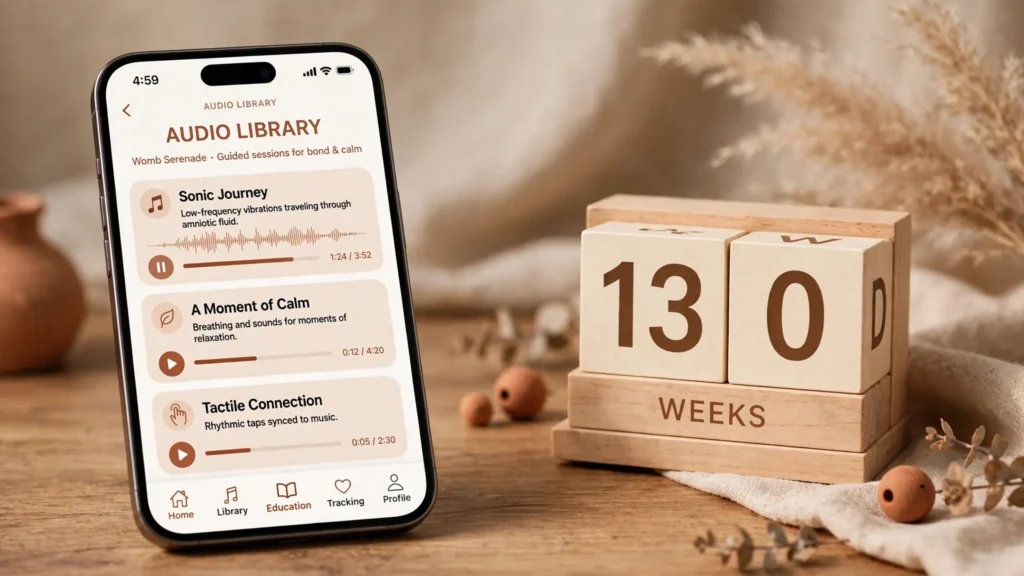
A pregnancy music app, on the other hand, focuses more on the experience of pregnancy through audio. It may provide calming music, relaxation audio, mindfulness experiences, prenatal bonding activities, or other ways to create intentional moments during pregnancy.
The two can overlap, but their primary purposes are different.
Understanding that difference can help you decide whether you need a tracking tool, an audio-focused pregnancy experience, or a broader pregnancy companion that combines both.
What Is a Pregnancy Tracker?
A pregnancy tracker is an app designed primarily to help you follow your pregnancy over time.
Common features include:
- Due-date calculations
- Pregnancy week tracking
- Trimester information
- Baby development information
- Pregnancy milestones
- Symptom tracking
- Appointment reminders
- Weight or health tracking
- Fetal movement tracking
- Contraction timing
- Pregnancy calendars
- Educational articles
A recent analysis of pregnancy apps found that week-by-week pregnancy information, general medical information, physiological data tracking, due-date calculations, calendars, nutrition information, and other tracking functions are common features among these apps.
The primary question a pregnancy tracker tries to answer is:
“Where am I in my pregnancy, and what should I know or prepare for at this stage?”
What Is a Pregnancy Music App?
A pregnancy music app has a different primary purpose.
Instead of focusing mainly on tracking pregnancy progress, it uses audio as an important part of the pregnancy experience.
Depending on the app, features may include:
- Pregnancy music
- Instrumental tracks
- Calming audio
- Relaxation music
- Mindfulness audio
- Guided breathing
- Prenatal bonding activities
- Audio routines
- Reflection
- Sleep or wind-down audio
The primary question becomes:
“How can I use sound and audio to create meaningful, calming moments during pregnancy?”
This does not mean every pregnancy music app provides the same features.
Some may focus almost entirely on music, while others may combine audio with pregnancy education, tracking, wellness, or other pregnancy-related features.
Pregnancy Music App vs. Pregnancy Tracker at a Glance
| Feature | Pregnancy Music App | Pregnancy Tracker |
|---|---|---|
| Pregnancy week tracking | Sometimes | Usually |
| Due-date tracking | Sometimes | Usually |
| Baby development information | Sometimes | Usually |
| Pregnancy milestones | Sometimes | Usually |
| Symptom tracking | Sometimes | Often |
| Music | Core feature | Usually secondary or absent |
| Relaxation audio | Common | Sometimes |
| Mindfulness | Common in wellness-focused apps | Sometimes |
| Prenatal bonding | May be central | Usually secondary |
| Journaling | May be included | Sometimes |
| Appointment organization | Sometimes | Common |
| Audio routines | Core or important feature | Usually not |
| Pregnancy education | May be included | Common |
| Wellness activities | Often | Sometimes |
| Main purpose | Audio and pregnancy experience | Pregnancy tracking and information |
The exact features vary between apps, so this table describes the typical distinction rather than a strict rule.
1. The Main Difference Is the Purpose
The biggest difference between the two types of apps is not necessarily the technology.
It is the purpose.
A pregnancy tracker is generally designed around information and monitoring.
A pregnancy music app is generally designed around listening and experience.
Think of it this way:
Pregnancy tracker:
“What’s happening with my pregnancy?”
Pregnancy music app:
“How can I create a calmer or more intentional moment during my pregnancy?”
Neither purpose is more important than the other.
They simply address different needs.
2. Pregnancy Trackers Focus on Progress
A pregnancy tracker usually organizes pregnancy according to time.
You might open the app to see:
- How many weeks pregnant you are
- What trimester you are in
- What changes may be happening
- Which milestones are approaching
- What appointments are coming up
- What information applies to your current stage
This makes tracking particularly useful for expectant parents who want a structured overview of their pregnancy journey.
3. Pregnancy Music Apps Focus on Experience
A pregnancy music app may be less concerned with asking where you are on a pregnancy timeline and more concerned with what you can experience in the moment.
For example, you might open the app because you want to:
- Relax after work
- Listen to calming music
- Practice mindfulness
- Create a prenatal bonding moment
- Journal
- Wind down before bed
- Take a quiet break
- Enjoy music while reflecting on your pregnancy
The experience is more immediate.
You are not necessarily trying to record something.
You are creating a moment.
4. Tracking Is About Information
Pregnancy tracking apps can provide a sense of structure.
For example:
Week 18
You may be able to see:
- Current pregnancy week
- Approximate developmental information
- Upcoming milestones
- Relevant educational content
- Suggested preparations
This type of information can help you understand how your pregnancy is progressing.
However, pregnancy apps should not be treated as substitutes for individualized medical advice.
Your healthcare provider remains the appropriate source for questions about your specific pregnancy.
5. Music Is About Creating an Environment
Music can change the atmosphere of a moment.
You might listen to calming instrumental music while:
- Sitting quietly
- Reading
- Journaling
- Stretching appropriately
- Preparing for bed
- Practicing mindfulness
- Spending time with your partner
The purpose is not necessarily to track anything.
The music helps create an environment that feels comfortable and intentional.
The CDC also recognizes listening to music as one possible way to create moments of relaxation, while emphasizing the importance of avoiding hazardous noise exposure during pregnancy.
6. Pregnancy Trackers Often Encourage Regular Check-Ins
A tracker naturally encourages you to return to the app.
You might check it:
- Every morning
- Once a week
- Before appointments
- When you experience a symptom
- When you reach a new pregnancy milestone
This makes sense because the information changes as your pregnancy progresses.
7. Music Apps Can Be More Flexible
Audio does not necessarily require a specific schedule.
You can listen:
- In the morning
- During lunch
- Before bed
- During a stressful moment
- While journaling
- While resting
- During a prenatal bonding routine
You can listen for five minutes or longer depending on what fits your day.
There is no requirement to use music every day.
8. Pregnancy Trackers Often Emphasize Baby Development
Many pregnancy trackers provide information about fetal development and changes occurring during pregnancy.
This can help expectant parents understand the general progression of pregnancy.
However, this information should always be understood as general educational information.
Pregnancies do not all develop according to an identical digital timeline, and individual questions should be discussed with a healthcare professional.
9. Pregnancy Music Apps Emphasize Relaxation and Reflection
A pregnancy music app may place greater emphasis on the mother’s experience.
That can include:
- Relaxation
- Reflection
- Mindfulness
- Emotional wellbeing
- Prenatal bonding
- Quiet time
- Audio routines
This can be especially appealing to expectant parents who already have a pregnancy tracker but want something that supports the emotional and experiential side of pregnancy.
10. A Pregnancy Tracker Can Tell You What Is Happening
Suppose you are 24 weeks pregnant.
A tracker may tell you:
- Your current pregnancy week
- General developmental information
- Upcoming milestones
- What changes you may notice
- What preparations may be relevant
It answers:
“What is happening?”
11. A Pregnancy Music App Can Help You Decide What to Do With the Moment
A music app might help you turn those few minutes into a quiet experience.
For example:
You finish work.
You sit somewhere comfortable.
You play a calming instrumental track.
You breathe slowly.
You reflect on your pregnancy.
You write a few sentences in your journal.
The app is not necessarily telling you what is happening medically.
It is helping you create a moment around your pregnancy.
12. Music Apps Can Support Prenatal Bonding
Prenatal bonding can take many forms.
Some parents enjoy:
- Talking to their baby
- Singing
- Reading aloud
- Listening to music
- Journaling
- Reflecting on the pregnancy
- Sharing activities with their partner
A pregnancy music app can make music part of that routine.
However, it is important not to confuse prenatal bonding with claims about guaranteed developmental effects.
Music can provide a meaningful experience for the parent without needing to promise that it will make a baby smarter or directly improve fetal development.
13. Pregnancy Trackers Are Often More Data-Oriented
Tracking naturally involves information.
You may record:
- Symptoms
- Weight
- Appointments
- Pregnancy milestones
- Dates
- Movement
- Notes
For some people, this is reassuring.
For others, constantly monitoring information can become overwhelming.
The best tracking routine is one that provides useful information without creating unnecessary anxiety.
14. Pregnancy Music Apps Can Be More Sensory
Audio apps engage you differently.
Instead of entering information, you are listening.
This can make the experience feel less like managing data and more like taking a break.
That distinction can matter during pregnancy because wellness is not only about monitoring what is happening.
It is also about making space for rest, connection, and enjoyment.
15. One Is Not Necessarily Better Than the Other
It is easy to turn app comparisons into a competition.
But a pregnancy tracker and a pregnancy music app can serve completely different purposes.
If you want:
Tracking → choose a tracker.
If you want:
Music and relaxation → consider a pregnancy music app.
If you want:
Both → look for a broader pregnancy companion.
The best choice depends on what you actually want from the experience.
16. You May Not Need to Choose Just One
There is no rule saying that you can only have one pregnancy app.
You might use:
A pregnancy tracker
for pregnancy weeks, milestones, appointments, and educational information.
A pregnancy music app
for relaxation, music, mindfulness, and prenatal bonding.
This can work well if the apps serve clearly different purposes.
However, if you prefer simplicity, an all-in-one pregnancy companion may be more convenient.
17. What Is a Pregnancy Companion App?
A pregnancy companion sits somewhere between a traditional tracker and a specialized wellness tool.
Rather than focusing on only one function, it may combine:
- Pregnancy tracking
- Milestones
- Education
- Audio
- Music
- Relaxation
- Prenatal bonding
- Journaling
- Wellness
- Postpartum preparation
The goal is to provide a broader pregnancy experience within one environment.
This can be useful for people who do not want to switch between several different apps.
18. Where Womb Serenade Fits
Womb Serenade is designed around this broader pregnancy companion concept.
While audio and pregnancy music are an important part of the experience, the app also incorporates pregnancy tracking, milestones, health education, and wellness-oriented support.
That means it does not have to be viewed simply as:
“a music app for pregnant women.”
It can instead be understood as an audio-first pregnancy companion that combines listening with other aspects of the pregnancy journey.
For example, an expectant mother might use it to:
- Listen to calming instrumental music
- Create a relaxation routine
- Reflect on pregnancy milestones
- Explore pregnancy education
- Build prenatal bonding moments
- Take a quiet break
- Keep aspects of her pregnancy journey organized
The audio experience can therefore become one part of a larger pregnancy wellness routine.
Womb Serenade is designed to complement not replace prenatal healthcare, medical advice, or professional mental health support.
19. What Should You Look for in a Pregnancy Music App?
If music is your main reason for downloading an app, consider:
Audio Quality
The listening experience should be pleasant and reliable.
Music Selection
Look for music that fits your personal preferences.
Relaxation Features
Consider whether the app includes calming audio, mindfulness, breathing, or other wellness experiences.
Ease of Use
You should be able to start listening without navigating through complicated menus.
Volume and Safety
The app should not encourage unnecessarily loud listening.
During pregnancy, the bigger concern is excessive noise exposure rather than ordinary comfortable listening. The CDC recommends reducing exposure to hazardous noise and avoiding areas above 115 dBA during pregnancy.
Privacy
If the app collects pregnancy or health-related information, understand what it collects and how that information is handled.
Additional Features
If you want more than music, look for features such as pregnancy education, tracking, milestones, or journaling.
20. What Should You Look for in a Pregnancy Tracker?
If tracking is your main priority, consider:
- Accurate pregnancy-week calculations
- Due-date tools
- Milestone information
- Educational content
- Appointment organization
- Symptom tracking
- Personal notes
- Pregnancy timeline
- Useful reminders
- Clear privacy practices
The tracker should make pregnancy information easier to organize rather than make you feel as though you need to monitor everything.
21. What If You Mainly Want Relaxation?
If relaxation is your primary goal, a traditional pregnancy tracker may not provide enough.
You may benefit more from an app that offers:
- Calming music
- Relaxation audio
- Mindfulness
- Breathing exercises
- Sleep or wind-down routines
- Journaling
- Quiet reflection
You can also combine these tools with non-digital activities such as walking, reading, stretching when appropriate, or simply taking a break.
22. What If You Want Pregnancy Information and Relaxation?
This is where a broader pregnancy companion can be useful.
Instead of choosing between information and experience, you can look for an app that combines both.
For example:
Morning:
Check your pregnancy progress.
Afternoon:
Read an educational resource.
Evening:
Listen to calming music and reflect on your day.
This creates a more complete pregnancy routine.
23. Can Pregnancy Music Replace a Pregnancy Tracker?
Not usually if your main goal is detailed pregnancy tracking.
A music-focused app may not provide the same depth of:
- Pregnancy timelines
- Symptom tracking
- Appointment organization
- Development information
- Milestone tracking
If these features are important to you, look for an app that includes them or use a dedicated tracker alongside your music app.
24. Can a Pregnancy Tracker Replace a Pregnancy Music App?
It can if music and relaxation are not priorities for you.
But a tracker may not provide the same intentional audio experience.
If listening to music helps you relax, reflect, or create prenatal bonding moments, an audio-focused app can serve a different purpose.
25. Think About the Experience You Want
Before downloading another pregnancy app, ask yourself:
Do I want to track my pregnancy?
If yes, a pregnancy tracker may be appropriate.
Do I want to relax and listen to music?
If yes, consider a pregnancy music or audio wellness app.
Do I want pregnancy education and wellness support?
Look for a broader pregnancy wellness app.
Do I want all of these in one place?
A pregnancy companion may be the better fit.
26. Pregnancy Music Apps Are Not About Making the Baby Smarter
This distinction is particularly important.
Some pregnancy music marketing has historically relied on claims suggesting that playing classical music or certain sounds to a baby will increase intelligence.
Parents should be cautious about such claims.
The value of pregnancy music does not depend on proving that it makes a baby smarter.
Music can be valuable because it may help the parent:
- Relax
- Enjoy the pregnancy
- Create routines
- Reflect
- Connect emotionally
- Share meaningful moments with a partner
Those are worthwhile benefits without making unsupported developmental promises.
27. Comfortable Listening Matters More Than Special Equipment
You do not need special speakers, headphones placed against your belly, or expensive equipment to enjoy music during pregnancy.
Normal listening at a comfortable volume is enough.
The CDC notes that very loud noise can be hazardous during pregnancy and recommends reducing exposure to high-noise environments.
If you are regularly exposed to loud workplace noise or intense vibration, discuss the exposure with your healthcare provider.
28. A Simple Way to Combine Tracking and Music
You can create a simple routine using both types of tools.
Step 1: Check In
Open your pregnancy tracker and review your current week.
Step 2: Learn
Read one reliable piece of pregnancy information relevant to your current stage.
Step 3: Pause
Put the phone aside for a few minutes.
Step 4: Listen
Play calming music at a comfortable volume.
Step 5: Reflect
Think about how you are feeling physically and emotionally.
Step 6: Record
If you want, write a short note in your pregnancy journal.
This creates a balance between tracking your pregnancy and experiencing it.
Frequently Asked Questions
What is the difference between a pregnancy music app and a pregnancy tracker?
A pregnancy tracker primarily focuses on monitoring and understanding pregnancy progress, such as pregnancy weeks, milestones, due dates, symptoms, and educational information. A pregnancy music app focuses more on audio experiences such as music, relaxation, mindfulness, and prenatal bonding.
Is a pregnancy music app the same as a pregnancy wellness app?
Not necessarily. A pregnancy music app may focus primarily on audio, while a broader pregnancy wellness app may include relaxation, mindfulness, education, tracking, self-care, and other features.
Do I need both a pregnancy tracker and a pregnancy music app?
Not necessarily. You may use both if they serve different purposes, or choose a broader pregnancy companion that combines tracking, audio, education, and wellness features.
Can music help me relax during pregnancy?
Music may help some people create a calmer environment and can be part of a relaxation routine. It should not be treated as a replacement for professional care if you are experiencing significant anxiety or other mental health concerns.
Is listening to music during pregnancy safe?
Ordinary listening at a comfortable volume is generally different from hazardous noise exposure. The CDC recommends reducing exposure to very loud noise during pregnancy and avoiding areas above 115 dBA.
Can I put headphones on my belly to play music to my baby?
There is no need to place headphones directly against your abdomen. Normal listening is sufficient, and very loud sound exposure should be avoided.
Does a pregnancy music app help with fetal development?
You should be cautious about apps that make strong claims about fetal development or intelligence. Music can be used for relaxation, enjoyment, reflection, and prenatal bonding without making unsupported developmental claims.
What is the advantage of an all-in-one pregnancy companion?
An all-in-one pregnancy companion can combine tracking, education, wellness, audio, milestones, and other features in one environment, reducing the need to switch between several specialized apps.
What makes Womb Serenade different from a traditional pregnancy tracker?
Womb Serenade takes an audio-first pregnancy companion approach. Alongside audio and music experiences, it incorporates pregnancy tracking, milestones, health education, and wellness-oriented features, giving expectant mothers more than a traditional tracking only experience.
Final Thoughts
A pregnancy music app and a pregnancy tracker may both live in the pregnancy-app category, but they are designed around different experiences.
A pregnancy tracker helps you follow your journey.
A pregnancy music app helps you experience moments within that journey.
One focuses more on information, progress, and organization. The other focuses more on sound, relaxation, reflection, and connection.
And increasingly, pregnancy apps do not have to fit into only one category.
A broader pregnancy companion can combine tracking and wellness so that expectant mothers can understand what is happening while also making space to slow down, relax, and connect with their pregnancy.
The best option depends on what you need.
If tracking is your priority, choose an app that does tracking well.
If music and relaxation are your priorities, look for a strong audio experience.
If you want both, consider a pregnancy companion that brings the two together.
Ultimately, technology should make pregnancy feel more supported not more complicated.