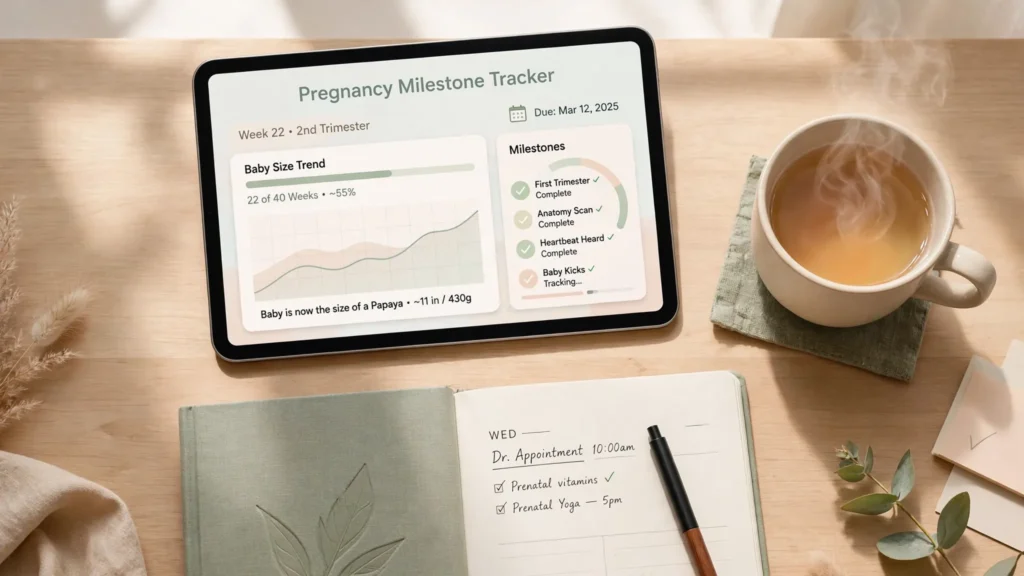
Pregnancy is a journey filled with changes, appointments, discoveries, and small moments that can make the experience feel more real.
From seeing a positive pregnancy test to hearing your baby’s heartbeat, feeling the first movements, attending important scans, and preparing for birth, each trimester brings its own milestones.
Knowing what to expect can help you feel more prepared and give you a clearer picture of how pregnancy progresses.

However, pregnancy does not follow exactly the same timeline for everyone. A milestone may happen earlier or later than expected, and some experiences may not happen at all.
This guide provides a general overview of pregnancy milestones throughout the three trimesters. Your healthcare professional should always be your primary source for advice about your individual pregnancy.
What Are Pregnancy Milestones?
Pregnancy milestones are significant moments, changes, appointments, or stages that occur throughout pregnancy.
Some are physical, such as your growing bump or feeling your baby move.
Others are medical, such as prenatal appointments, blood tests, or ultrasound scans.
Some are emotional and personal, such as telling your partner, hearing your baby’s heartbeat, choosing a name, or creating your first prenatal bonding routine.
Pregnancy milestones can include:
- Confirming your pregnancy
- Starting prenatal care
- Early pregnancy symptoms
- Your first ultrasound
- First-trimester screening
- Entering the second trimester
- Feeling your baby move
- The mid-pregnancy ultrasound
- Tracking your baby’s movements
- Entering the third trimester
- Preparing for birth
- Creating a postpartum support plan
- Reaching the final weeks of pregnancy
Not every milestone will happen on exactly the same week for every person.
Pregnancy Milestones at a Glance
Pregnancy is commonly divided into three trimesters.
First Trimester
Approximately weeks 1–12
This is the stage when pregnancy begins, early development occurs, and you establish prenatal care.
Common milestones include:
- Confirming pregnancy
- Starting prenatal care
- Managing early pregnancy symptoms
- Initial blood tests and screening
- Dating or early ultrasound
- Reaching the end of the first trimester
Second Trimester
Approximately weeks 13–27
This stage often brings noticeable physical changes and, later in the trimester, the first sensations of fetal movement.
Common milestones include:
- Entering the second trimester
- Growing pregnancy bump
- Improving early pregnancy symptoms for some people
- Feeling the first fetal movements
- Mid-pregnancy ultrasound
- Learning more about your baby’s development
- Preparing for the third trimester
Third Trimester
Approximately week 28 until birth
The final trimester is a period of continued fetal growth, increasing physical changes, and preparation for birth and postpartum life.
Common milestones include:
- Entering the third trimester
- Increasing awareness of fetal movement
- More frequent prenatal care
- Preparing for labor and birth
- Organizing practical support
- Final pregnancy appointments
- Reaching the final weeks
The exact timing of appointments and screening differs between countries, healthcare systems, and individual pregnancies. For example, the NHS currently describes a dating scan around 11–14 weeks and a mid-pregnancy scan around 18–21 weeks, while prenatal care schedules can vary elsewhere.
First Trimester Pregnancy Milestones
The first trimester can feel like a period of discovery.
You may be adjusting to the idea that you are pregnant while your body is already undergoing significant changes.
Milestone 1: Confirming Your Pregnancy
For many people, the first major milestone is getting a positive pregnancy test.
You may feel excited, nervous, surprised, relieved, or a mixture of emotions.
There is no single correct emotional response.
A positive test can also bring practical questions:
- When should I schedule my first appointment?
- What foods or drinks should I avoid?
- Which medications are safe?
- What supplements should I take?
- When should I tell family or friends?
- What symptoms should I expect?
Your healthcare professional can help answer questions based on your circumstances.
Milestone 2: Starting Prenatal Care
Beginning prenatal care is one of the most important early pregnancy milestones.
Your first appointments may involve discussing:
- Your medical history
- Previous pregnancies
- Current medications
- Supplements
- General health
- Pregnancy symptoms
- Blood tests
- Screening options
- Your estimated due date
- Questions or concerns
Prenatal care is also an opportunity to discuss your emotional wellbeing.
Do not hesitate to tell your healthcare professional if you feel unusually anxious, overwhelmed, or emotionally distressed.
Milestone 3: Experiencing Early Pregnancy Symptoms
Early pregnancy symptoms can be another major milestone because they make the pregnancy feel physically real.
Possible symptoms include:
- Nausea
- Fatigue
- Breast tenderness
- Increased urination
- Changes in appetite
- Food aversions
- Heightened sensitivity to smells
- Bloating
- Mood changes
Not everyone experiences the same symptoms.
Some people have significant symptoms, while others experience relatively few.
The NHS notes that pregnancy symptoms vary and provides week-specific guidance throughout the first trimester.
Milestone 4: Your First Ultrasound or Dating Scan
An early ultrasound may be offered to help establish pregnancy dating and assess development.
In the NHS system, a dating scan is generally offered between 11 and 14 weeks. It may also be combined with screening depending on the individual’s circumstances and choices.
Seeing the pregnancy on an ultrasound can be an emotional milestone.
For some parents, it is the first time the pregnancy feels visually real.
Milestone 5: First-Trimester Screening
Depending on where you live and your individual circumstances, you may be offered screening tests during the first trimester.
These can include blood tests and ultrasound-based screening.
Screening does not provide certainty that a baby has or does not have a particular condition. Your healthcare professional can explain what each test means, its limitations, and what your options are.
In the NHS, screening for conditions such as Down’s syndrome, Edwards’ syndrome, and Patau’s syndrome can be offered as part of first-trimester screening.
Milestone 6: Reaching the End of the First Trimester
Around week 12, you are approaching the end of the first trimester.
For some people, early pregnancy symptoms may begin improving around this stage. Others may continue experiencing nausea or fatigue.
You may also begin feeling more comfortable telling people about the pregnancy or making plans for the months ahead.
This can be a good time to think about:
- Your pregnancy wellness routine
- Prenatal bonding
- Nutrition
- Appropriate physical activity
- Emotional support
- Upcoming appointments
- Pregnancy education
Second Trimester Pregnancy Milestones
The second trimester often brings a different experience.
Your pregnancy may become more visible, your baby continues developing rapidly, and you may begin experiencing some of the most memorable moments of pregnancy.
Milestone 7: Entering the Second Trimester
Around week 13, you enter the second trimester.
For some people, early pregnancy symptoms begin to ease.
You may notice:
- More energy
- A growing appetite
- A more noticeable bump
- Continued breast changes
- Changes in skin and hair
- Occasional physical discomfort
However, there is no requirement to feel better simply because you have entered the second trimester.
Pregnancy experiences vary.
Milestone 8: Your Pregnancy Bump Becomes More Noticeable
At some point during the second trimester, your pregnancy may become more visible.
When this happens varies considerably.
Factors such as body shape, whether you have been pregnant before, your individual pregnancy, and other factors can influence when your bump becomes noticeable.
Try not to compare your bump with photographs or videos of other pregnant people.
There is no single appearance that a healthy pregnancy should have.
Milestone 9: Feeling Your Baby Move
One of the most memorable pregnancy milestones is feeling your baby move for the first time.
The first movements may feel like:
- Fluttering
- Bubbling
- Gentle tapping
- Rolling
- Small flicks
The NHS notes that many women first notice movements between approximately 18 and 24 weeks, although timing varies.
At first, it may be difficult to know whether what you are feeling is your baby’s movement or something else.
Over time, movements may become easier to recognize.
If you have concerns about your baby’s movements, particularly after you have established a pattern of movement, contact your maternity or healthcare team for advice rather than relying on comparisons with other pregnancies.
Milestone 10: The Mid-Pregnancy Ultrasound
Another important milestone is the mid-pregnancy or anatomy scan.
In the NHS, the 20-week screening scan is usually performed between 18 and 21 weeks. It assesses the baby’s development and looks for signs of certain physical conditions. The scan also examines the placenta and other aspects of the pregnancy.
This scan can be an important appointment for expectant parents.
It may also generate questions, emotions, or additional appointments depending on the findings.
Your healthcare team can explain your individual results and what they mean.
Milestone 11: Developing a Prenatal Bonding Routine
As your pregnancy becomes more tangible, you may want to create intentional moments of connection with your baby.
Prenatal bonding can be simple.
You might:
- Talk to your baby
- Read aloud
- Listen to music
- Sing
- Journal
- Reflect on pregnancy milestones
- Spend quiet time with your partner
- Create a special pregnancy playlist
These activities are not about guaranteeing a particular developmental outcome.
They are opportunities for you to slow down and acknowledge the pregnancy.
For more ideas, explore our guide to how to bond with your baby during pregnancy and our article on prenatal bonding activities for partners.
Milestone 12: Starting to Prepare for the Third Trimester
As you approach week 28, your pregnancy may start to feel increasingly physical.
You may begin thinking more seriously about:
- Birth preparation
- Baby essentials
- Work arrangements
- Childcare
- Transportation
- Postpartum support
- Feeding plans
- Emotional support
- Your birth preferences
You do not need to have everything decided immediately.
Preparation can happen gradually.
Third Trimester Pregnancy Milestones
The third trimester is the final major stage of pregnancy.
Your baby’s growth continues while your body prepares for labor and birth.
Milestone 13: Entering the Third Trimester
Around week 28, you enter the third trimester.
Your baby continues growing and developing, while physical symptoms may become more noticeable.
You might experience:
- Back discomfort
- Heartburn
- Increased urination
- Difficulty sleeping
- Leg cramps
- Increasing fatigue
- Swelling
- Shortness of breath
- Increasing abdominal size
Not everyone experiences all of these symptoms.
Your healthcare team can help you distinguish common pregnancy discomforts from symptoms that need medical attention.
Milestone 14: Becoming More Aware of Your Baby’s Movement Pattern
By the third trimester, many expectant parents become increasingly familiar with their baby’s movements.
You may begin to recognize periods when your baby tends to be more active.
The important point is not to compare your baby’s movement pattern with someone else’s.
If you notice a significant change or reduction in your baby’s movements, contact your healthcare or maternity team promptly for guidance.
Milestone 15: More Frequent Prenatal Monitoring
As pregnancy progresses, prenatal appointments often become more frequent.
The exact schedule depends on your healthcare system and individual needs.
Appointments may include discussions or checks involving:
- Blood pressure
- Urine
- Baby’s growth
- Baby’s position
- Fetal movement
- Your physical symptoms
- Your emotional wellbeing
- Birth preparation
- Screening or testing
For example, the NHS schedule includes appointments around 28, 31, 34, 36, 38, 40, and 41 weeks, with some additional appointments depending on whether it is a first pregnancy and individual circumstances.
Your own schedule may be different.
Milestone 16: Preparing for Labor and Birth
As your due date approaches, birth preparation becomes increasingly relevant.
You may want to learn about:
- Signs of labor
- Different birth settings
- Pain-relief options
- Birth preferences
- Who you want with you
- Transportation
- What to pack
- What happens immediately after birth
- Newborn care
- Feeding
- Postpartum recovery
A birth plan can be useful as a way to communicate preferences, but birth does not always follow the original plan.
Flexibility can be helpful.
Milestone 17: Preparing for Life After Birth
Pregnancy preparation should not stop at the moment your baby arrives.
Think about the postpartum period too.
Consider:
- Who can help with meals?
- Who can assist around the house?
- Who can provide emotional support?
- How will you get to appointments?
- What newborn supplies will you need?
- Where will you sleep?
- What support will your partner need?
- Who can you contact if you are struggling emotionally?
Creating a support plan before birth can make the transition into parenthood feel more manageable.
Milestone 18: Reaching the Final Weeks
The final weeks can feel both exciting and uncertain.
You may be watching for signs of labor while continuing to attend prenatal appointments.
Your healthcare professional can explain:
- What signs of labor to look for
- When to contact your maternity team
- What to do if your waters break
- How fetal movement should be monitored
- What happens if pregnancy continues beyond your estimated due date
Remember that an estimated due date is not an exact appointment for birth.
Some babies arrive earlier, while others arrive later.
Milestone 19: Meeting Your Baby
Eventually, the pregnancy milestones lead to one of the biggest transitions of all: meeting your baby.
The experience of labor and birth varies widely.
Whether your birth happens according to your original preferences or requires unexpected changes, the most important thing is receiving appropriate medical care and support.
Once your baby arrives, pregnancy becomes postpartum recovery and the beginning of a new stage of parenthood.
Emotional Pregnancy Milestones Matter Too
Not every milestone appears on a medical chart.
Some of the most meaningful moments are personal.
You might remember:
- The first time you realized you were pregnant
- Telling your partner
- Telling your family
- Seeing your baby on an ultrasound
- Hearing your baby’s heartbeat
- Feeling movement for the first time
- Buying your first baby item
- Choosing a name
- Creating a nursery
- Writing a letter to your baby
- Listening to a special song during pregnancy
- Feeling your baby respond to a familiar routine
These moments can become part of your personal pregnancy story.
Create a Pregnancy Milestone Journal
A pregnancy journal can be a simple way to preserve these memories.
You could create a weekly or monthly entry containing:
Pregnancy week:
What week are you in?
How I feel:
What are you experiencing physically and emotionally?
Baby milestone:
What has changed or become noticeable?
Personal milestone:
What meaningful moment happened this week?
Questions:
What would you like to ask your healthcare professional?
Memory:
What do you want to remember?
Music:
Was there a song or piece of music you enjoyed this week?
This does not need to become a complicated project.
Even a few sentences can create a meaningful record.
Using Music During Pregnancy Milestones
Music can provide a simple way to mark different stages of pregnancy.
You might create different playlists for different moments:
First Trimester
Music for quiet reflection and adjusting to the pregnancy.
Second Trimester
Music for relaxation, prenatal bonding, or celebrating new milestones such as feeling your baby move.
Third Trimester
Music for rest, reflection, preparation, and quiet moments before birth.
There is no scientifically required pregnancy playlist.
Choose music that you enjoy and that makes your routine feel meaningful.
For additional guidance, explore our articles on calming music during pregnancy.
How Womb Serenade Can Help You Mark Pregnancy Milestones
Pregnancy milestones are not only things to remember they can also become opportunities to slow down and connect with your pregnancy.
Womb Serenade can be incorporated into these moments by bringing together pregnancy-focused audio, tracking, education, and opportunities for reflection.
For example, you might use Womb Serenade when:
- Marking the beginning of a new trimester
- Reflecting on a weekly pregnancy milestone
- Listening to music after an appointment
- Creating a prenatal bonding routine
- Taking a quiet break during a busy day
- Preparing for bedtime
- Reflecting on your journey before birth
Rather than treating pregnancy as a checklist, these small rituals can help you become more intentional about experiencing the journey.
Womb Serenade is designed to complement prenatal care, not replace medical appointments or professional advice.
Pregnancy Milestones You Should Not Compare
Social media can make pregnancy look extremely predictable.
One person may feel movement at 17 weeks.
Another may feel it later.
One person may show early.
Another may not show much until later.
One person may experience severe nausea.
Another may experience very little.
These differences do not automatically indicate a problem.
Pregnancy milestones are useful for understanding general patterns, but your healthcare professional is the right person to interpret your individual pregnancy.
What If You Miss a Milestone?
Not every pregnancy experience happens at the same time.
If you have not experienced a particular milestone when you expected to, avoid immediately assuming something is wrong.
Instead:
- Check reliable pregnancy information.
- Consider whether the milestone has a broad normal timeframe.
- Write down your concern.
- Discuss it with your healthcare professional.
- Seek prompt medical advice if you have concerning symptoms.
A pregnancy article cannot diagnose an individual pregnancy.
When Should You Contact Your Healthcare Professional?
Contact your healthcare professional if you have concerns about your pregnancy or notice a significant change in your symptoms or your baby’s movements.
Seek urgent medical attention for symptoms such as heavy bleeding, severe abdominal pain, severe headache with vision changes, difficulty breathing, chest pain, or other symptoms that your healthcare team has identified as requiring urgent assessment.
If your baby has established a pattern of movement and you notice a significant reduction or change, contact your maternity team promptly.
Do not wait for a general pregnancy milestone guide to tell you whether a symptom is serious.
Frequently Asked Questions About Pregnancy Milestones
What are the most important pregnancy milestones?
Important milestones can include confirming pregnancy, beginning prenatal care, first-trimester screening, ultrasound scans, feeling fetal movement, the mid-pregnancy scan, entering the third trimester, preparing for birth, and reaching the final weeks of pregnancy.
Personal milestones such as hearing your baby’s heartbeat, feeling movement, or creating your first prenatal bonding routine can also be meaningful.
When do most pregnancy milestones happen?
The timing varies. Some milestones have approximate windows, while others depend on individual circumstances. For example, many people first notice fetal movement between approximately 18 and 24 weeks, but this varies.
When do you feel the baby move for the first time?
Many people begin feeling movement between around 18 and 24 weeks. It can initially feel like fluttering, bubbling, or gentle movement.
When is the 20-week scan?
In the NHS, the 20-week screening scan is usually performed between 18 and 21 weeks. Other healthcare systems may use different schedules.
Should I track my pregnancy milestones?
Tracking milestones can help you remember important moments, organize questions, and stay aware of appointments. However, tracking should complement rather than replace prenatal care.
What if my pregnancy does not match a week-by-week guide?
That can happen. Pregnancy symptoms and milestones vary significantly. If you are concerned about your symptoms, development, or fetal movement, speak with your healthcare professional.
Can music be part of pregnancy milestones?
Yes. Music can become part of personal pregnancy rituals, such as celebrating a new trimester, relaxing after an appointment, journaling, or creating prenatal bonding moments. It should be viewed as a wellness and connection activity rather than a treatment or a way to guarantee a particular developmental outcome.
Final Thoughts
Pregnancy milestones give you a way to understand the broad journey from early pregnancy through birth.
Some milestones are medical.
Some are physical.
Others are deeply personal.
A first ultrasound, a growing bump, the first flutter of movement, an important appointment, a new trimester, or simply the realization that you are getting closer to meeting your baby can all become meaningful parts of your story.
Try not to turn pregnancy into a race to reach the next milestone.
Your pregnancy may not look exactly like someone else’s, and that is okay.
Use reliable information to understand what is generally expected, stay connected with your healthcare team, and give yourself space to experience pregnancy at your own pace.
And when you want to pause and appreciate the journey, simple rituals such as music, journaling, mindfulness, prenatal bonding, and pregnancy reflection can help you create meaningful moments along the way.
Womb Serenade can be one supportive part of that experience, bringing together audio, pregnancy tracking, education, and opportunities for intentional connection throughout the pregnancy journey.
Your pregnancy is not just a series of weeks on a calendar.
It is a collection of moments.