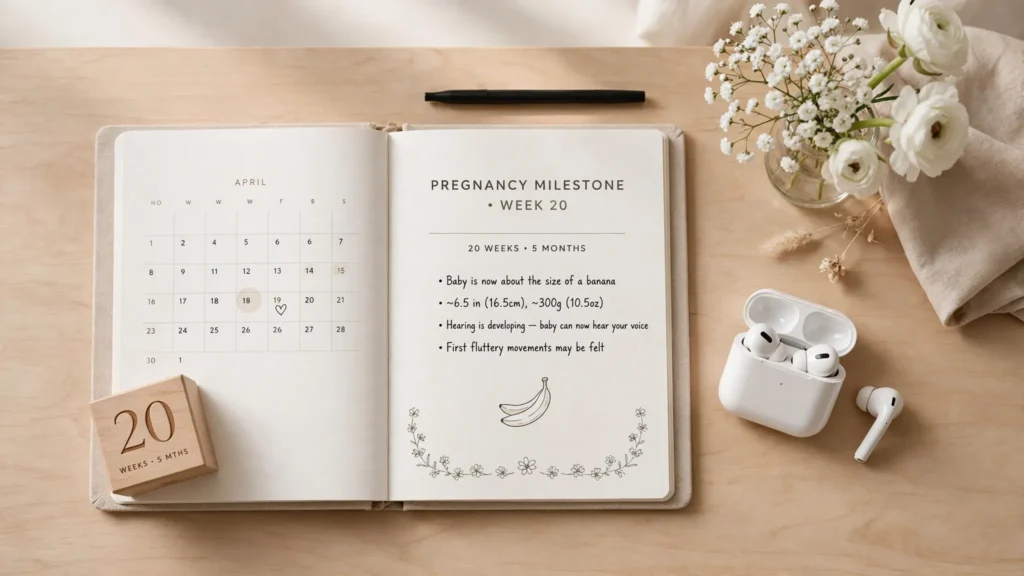
Pregnancy is filled with changes.
One week you may be adjusting to early pregnancy symptoms, and a few weeks later you may be noticing your growing bump, attending an ultrasound, or feeling your baby move for the first time.
With so much happening, it can be helpful to have a simple way to keep track of your pregnancy progress.
Pregnancy tracking can help you remember appointments, record milestones, organize questions for your healthcare professional, reflect on how you are feeling, and create a personal record of your journey.
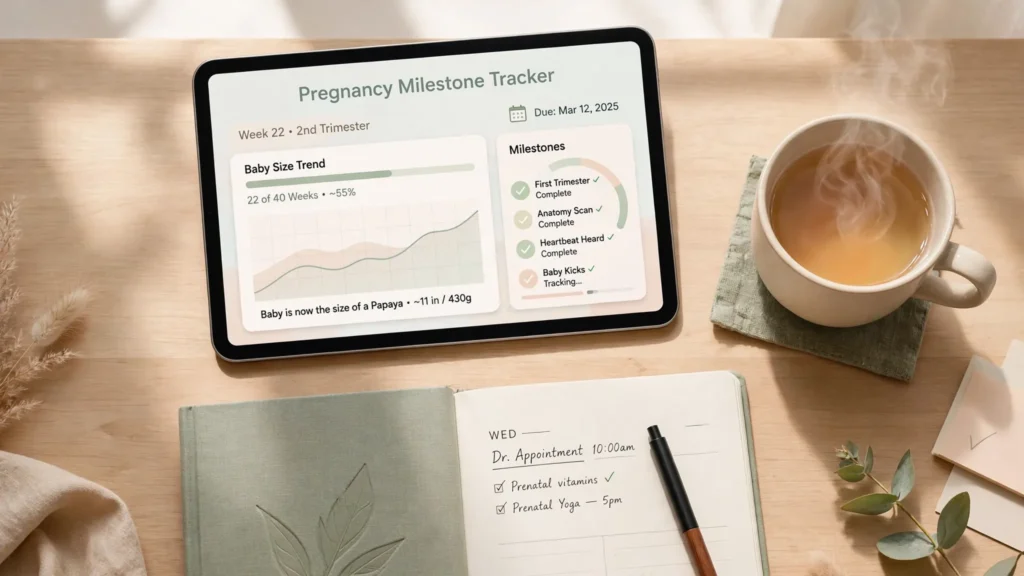
But pregnancy tracking should not become another source of pressure.
You do not need to record every symptom or compare your pregnancy with someone else’s. The goal is to create a system that helps you feel informed and organized while leaving medical interpretation to your healthcare team.
In this guide, we will explore practical ways to keep track of your pregnancy progress, what information may be useful to record, and how a pregnancy app can fit into your routine.
What Does Pregnancy Progress Tracking Mean?
Pregnancy progress tracking means keeping a record of important information and experiences throughout pregnancy.
Depending on your preferences, you might track:
- Your current pregnancy week
- Estimated due date
- Prenatal appointments
- Ultrasound scans
- Screening and test dates
- Pregnancy symptoms
- Fetal movement
- Pregnancy milestones
- Questions for your healthcare professional
- Emotional wellbeing
- Nutrition and hydration habits
- Physical activity
- Personal memories
- Preparation tasks
- Important healthcare information
You do not have to track all of these.
A simple system containing only the information that matters most to you may be enough.
Why Keep Track of Your Pregnancy Progress?
Pregnancy tracking can be useful for several reasons.
1. It helps you stay organized
Pregnancy can involve multiple appointments, tests, scans, and decisions.
A tracker gives you one place to record important dates and reminders.
2. It helps you remember milestones
Pregnancy can move quickly.
Recording important moments can help you remember how your journey changed over time.
3. It helps you prepare questions
Instead of trying to remember a question during an appointment, you can write it down when it occurs to you.
4. It can help you communicate with your healthcare team
Keeping notes about symptoms or concerns can make it easier to explain changes during appointments.
5. It creates a personal record
Your pregnancy tracker can become more than a checklist.
It can become a record of thoughts, memories, photographs, milestones, and meaningful moments.
1. Start With Your Estimated Due Date
One of the first pieces of information to record is your estimated due date.
Your healthcare professional can help establish or confirm your pregnancy dating.
Pregnancy is generally dated from the first day of your last menstrual period, and your estimated due date may later be adjusted based on clinical information and, where appropriate, ultrasound dating.
Remember that a due date is an estimate.
Your baby does not have to arrive on that exact day.
Once you know your estimated due date, you can use it as a reference point for understanding your pregnancy week and trimester.
2. Track Your Current Pregnancy Week
Knowing your current pregnancy week can help you understand where you are in the broader pregnancy journey.
For example, you might record:
Pregnancy week: 18
Trimester: Second
Estimated due date: Your healthcare provider’s estimated date
You can then use reliable week-by-week resources to learn about general changes that may occur around that stage.
Our guide to [pregnancy week by week] can provide a broader overview of the pregnancy journey.
However, remember that week-by-week information describes general patterns. It does not predict exactly what your individual pregnancy should look like.
3. Keep a Record of Prenatal Appointments
Prenatal appointments are an important part of pregnancy care.
Create a section in your tracker for:
- Appointment date
- Healthcare professional
- Questions to ask
- Tests or screenings discussed
- Follow-up date
- Personal notes
You might also write down questions between appointments.
For example:
Questions for my next appointment
- Is this symptom expected?
- Can I continue my current exercise routine?
- What should I know about the next screening?
- Are there foods or medications I should discuss?
- What should I expect during the next trimester?
You do not need to remember everything during an appointment.
Writing things down can help you make better use of your time with your healthcare team.
4. Record Ultrasounds and Screening Milestones
Pregnancy can involve several scans and screening tests depending on your healthcare system and individual circumstances.
Avoid using your tracker to interpret medical test results yourself.
If a result is unclear, ask your healthcare professional what it means for your individual pregnancy.
For example, a screening test estimates the likelihood of certain conditions; it is not necessarily a diagnosis.
5. Track Pregnancy Symptoms
A simple symptom record can help you notice patterns and remember what you want to discuss with your healthcare professional.
You might record:
- Nausea
- Fatigue
- Heartburn
- Headaches
- Back discomfort
- Sleep changes
- Appetite changes
- Swelling
- Mood changes
You can keep the record simple.
For example:
Monday: Mild nausea in the morning.
Tuesday: Felt more tired than usual.
Wednesday: Nausea improved.
The purpose is not to diagnose yourself.
Instead, it gives you a clearer record of what you have experienced.
6. Track How You Are Feeling Emotionally
Pregnancy tracking does not have to focus only on physical changes.
Your emotional wellbeing is also part of your pregnancy experience.
You could occasionally ask yourself:
- How am I feeling today?
- What has been making me happy?
- What has been worrying me?
- Do I feel supported?
- Am I getting enough time to rest?
- Is there something I need help with?
You could record a simple word or sentence rather than writing a full journal entry.
For example:
This week: Excited but a little nervous about the upcoming scan.
Over time, these small notes can help you recognize how your emotional experience changes throughout pregnancy.
If anxiety, sadness, or distress becomes persistent or begins interfering with your everyday life, talk with your healthcare professional.
7. Record Your Pregnancy Milestones
Pregnancy milestones can make the journey feel more tangible.
You might record:
- Positive pregnancy test
- First prenatal appointment
- First ultrasound
- Hearing your baby’s heartbeat
- First noticeable movement
- Feeling regular movement
- Finding out your baby’s sex, if you choose to
- Baby shower
- Preparing the nursery
- Choosing a name
- Reaching a new trimester
- Preparing your hospital or birth bag
Some milestones are medical.
Others are completely personal.
Your tracker should make room for both.
For a deeper look at important pregnancy milestones, explore our guide to pregnancy milestones throughout each trimester.
8. Track Fetal Movement Responsibly
As pregnancy progresses, you may become more aware of your baby’s movements.
Your healthcare professional can explain what to expect based on your individual pregnancy and when you should begin paying particular attention to movement patterns.
Once you have established a usual pattern of movement, a noticeable reduction or change should be taken seriously.
Do not rely on an app to reassure you that reduced movement is normal.
If you are concerned about your baby’s movements, contact your maternity or healthcare team promptly.
Pregnancy tracking tools should support communication with your healthcare team, not replace it.
9. Keep a Pregnancy Journal
A pregnancy journal is one of the simplest ways to track the personal side of pregnancy.
You do not need to write every day.
Try writing once a week.
You could answer:
How am I feeling?
What has changed this week?
What am I looking forward to?
What has surprised me?
What question do I want to ask my healthcare professional?
What do I want to remember?
You can also include photographs, ultrasound memories, favorite songs, messages to your baby, or notes about meaningful experiences.
10. Take Weekly or Monthly Pregnancy Photos
Photographs can provide a visual record of how your pregnancy changes.
Some people enjoy taking a weekly photograph in the same location and wearing similar clothing.
Others prefer monthly photographs.
There is no correct approach.
If you choose to do this, focus on documenting your experience rather than comparing your body with other pregnant people.
Pregnancy bumps can look very different from one person to another.
11. Track Your Pregnancy by Trimester
Instead of focusing only on individual weeks, you can organize your tracker into three broad sections.
First Trimester
You might record:
- Pregnancy confirmation
- First appointment
- Early symptoms
- Initial tests
- First ultrasound
- Emotional adjustment
Second Trimester
You might record:
- Growing bump
- Changes in energy
- First fetal movements
- Mid-pregnancy ultrasound
- Pregnancy milestones
- Preparation plans
Third Trimester
You might record:
- Increasing physical changes
- Movement patterns
- Prenatal appointments
- Birth preparation
- Baby preparations
- Postpartum support planning
This can make a long pregnancy feel easier to understand.
12. Keep Track of Questions for Your Healthcare Team
One of the most useful features of a pregnancy tracker can be a simple question list.
Create a note titled:
Questions for my next appointment
Whenever something comes to mind, add it.
Your list might include:
- Is this symptom normal?
- What should I expect at my next appointment?
- Are there any recommended tests?
- Can I continue this activity?
- What should I know about the next trimester?
- When should I contact the maternity team?
- What should I know about preparing for birth?
This prevents you from relying on memory during appointments.
13. Track Healthy Habits Without Becoming Obsessed
You may also want to record habits such as:
- Drinking fluids
- Eating regular meals
- Physical activity
- Rest
- Relaxation
- Sleep
- Prenatal vitamins or medications as directed
However, tracking should remain supportive.
If recording every glass of water, every meal, or every minute of exercise makes you anxious, simplify the system.
Pregnancy self-care should not become another source of stress.
For practical ideas, explore our guide to pregnancy self-care.
14. Create a Weekly Pregnancy Check-In
A weekly check-in can bring your tracking system together.
Set aside five to ten minutes once a week.
Ask:
Physical
How am I feeling physically?
Emotional
How am I feeling emotionally?
Baby
Have I noticed any meaningful changes?
Appointments
Do I have an upcoming appointment?
Questions
What do I want to ask my healthcare professional?
Personal
What is one thing I want to remember about this week?
Self-care
What do I need more of next week?
This small routine can help you stay connected with your pregnancy without constantly thinking about tracking.
15. Use a Pregnancy App
A pregnancy app can make tracking more convenient because it can bring several types of information together in one place.
Depending on the app, features may include:
- Pregnancy week tracking
- Estimated due date
- Milestone information
- Appointment reminders
- Symptom tracking
- Pregnancy education
- Journaling
- Fetal movement tracking
- Wellness resources
- Personalized content
When choosing a pregnancy app, consider whether the information is clear, trustworthy, easy to use, and appropriate for your needs.
Privacy is also worth considering.
Before entering personal information, review the app’s privacy policy and understand what information it collects and how it is used.
For more guidance, read what to look for in a pregnancy companion app.
16. Choose a Tracking Method That Fits Your Lifestyle
You do not have to use a smartphone app.
There are several ways to track pregnancy progress.
Smartphone app
Useful if you want reminders, automatic week calculations, and multiple features in one place.
Physical journal
Ideal if you enjoy writing and want something tangible.
Calendar
Useful for appointments, scans, and important dates.
Spreadsheet
Helpful if you prefer organizing information into categories.
Combination approach
You can use an app for practical tracking and a journal for personal memories.
The best method is the one you will actually use.
17. Keep Medical Information Separate From Personal Memories
One useful organizational approach is to have two sections.
Pregnancy care
Include:
- Appointments
- Tests
- Screening
- Questions
- Medication information
- Healthcare instructions
Pregnancy memories
Include:
- Photos
- Journal entries
- Songs
- Personal milestones
- Messages to your baby
- Special moments
This keeps medical information easier to find while giving you a separate space for the emotional side of pregnancy.
18. Make Music Part of Your Pregnancy Tracking Ritual
Pregnancy tracking does not have to feel clinical.
You can turn your weekly check-in into a small ritual.
For example:
Step 1: Open your pregnancy tracker.
Step 2: Review your current week and upcoming appointments.
Step 3: Write down one physical or emotional observation.
Step 4: Record one pregnancy milestone.
Step 5: Play a calming piece of music.
Step 6: Spend a few quiet minutes reflecting on your pregnancy.
This creates an opportunity to connect with the journey rather than simply checking boxes.
For more ideas, explore calming music during pregnancy.
19. Use Womb Serenade as Part of Your Pregnancy Tracking Routine
Womb Serenade can fit naturally into a pregnancy-tracking routine by combining pregnancy-focused audio, milestones, education, and opportunities for reflection.
For example, during a weekly check-in, you might:
- Review where you are in your pregnancy
- Reflect on recent milestones
- Explore relevant pregnancy information
- Listen to calming audio
- Spend a few minutes connecting with your baby
- Record something meaningful about the week
This turns pregnancy tracking from a purely informational activity into a more intentional weekly ritual.
Womb Serenade is not intended to replace prenatal appointments, medical records, professional advice, or emergency care.
Instead, it can complement your pregnancy journey by bringing supportive tools and pregnancy-focused resources into your everyday routine.
What You Should Not Rely on Pregnancy Apps to Do
Pregnancy apps can be useful, but they have limitations.
Do not use an app to:
- Diagnose pregnancy complications
- Interpret a concerning symptom without professional advice
- Replace prenatal appointments
- Replace medical tests
- Determine whether a pregnancy is healthy
- Reassure you when fetal movement has significantly changed
- Replace emergency medical care
An app can provide information and organization.
Your healthcare team provides individualized medical care.
Avoid Comparing Your Pregnancy Progress With Someone Else’s
One of the biggest problems with pregnancy tracking can be comparison.
You might see another person’s pregnancy and wonder:
- Why is their bump bigger?
- Why did they feel movement earlier?
- Why do they have different symptoms?
- Why does their pregnancy look different?
- Why am I not experiencing the same milestone?
Pregnancy varies significantly between individuals.
A tracking tool should help you understand your own pregnancy journey—not measure yourself against someone else’s.
What If You Miss a Week of Tracking?
Nothing is wrong with taking a break.
You do not have to maintain a perfect pregnancy record.
If you miss a week, simply continue when you are ready.
You can write:
Week 22–23:
“I didn’t track this week, but I remember feeling more energetic and noticing more movement.”
That is enough.
Your pregnancy is happening whether or not you document every detail.
Frequently Asked Questions About Pregnancy Tracking
What is the best way to track pregnancy progress?
There is no single best method. You can use a pregnancy app, journal, calendar, spreadsheet, or combination of tools. Choose a method that makes it easy for you to record appointments, milestones, questions, and personal experiences.
What should I track during pregnancy?
Useful information can include your pregnancy week, estimated due date, appointments, scans, symptoms, questions, pregnancy milestones, emotional wellbeing, and personal memories.
Should I track pregnancy symptoms every day?
You can, but you do not have to. If daily tracking makes you anxious or overwhelmed, consider recording symptoms only when something changes or when you want to discuss something with your healthcare professional.
Can a pregnancy app replace my doctor?
No. A pregnancy app can help you organize information and learn about general pregnancy topics, but it cannot replace prenatal care or individualized medical advice.
Should I track my baby’s movements?
Your healthcare professional can explain when and how to pay attention to fetal movement based on your pregnancy. Once a pattern has become established, a noticeable change or reduction in movement should be discussed promptly with your maternity or healthcare team.
How often should I update my pregnancy tracker?
Weekly updates are enough for many people. You can also update it after appointments or whenever something meaningful happens.
What if my pregnancy progress does not match an app?
Do not assume that something is wrong simply because your experience differs from an app’s general timeline. Pregnancy milestones can vary. If you are concerned, ask your healthcare professional.
Can pregnancy tracking help with prenatal bonding?
It can create opportunities to pause and reflect on your pregnancy. Combining tracking with journaling, music, talking to your baby, or other prenatal bonding activities can make your routine feel more personal and meaningful.
Final Thoughts
Keeping track of your pregnancy progress does not mean documenting every symptom, appointment, or feeling.
It means creating a simple system that helps you stay organized, understand the broad stages of pregnancy, remember meaningful milestones, and communicate effectively with your healthcare team.
You might use a pregnancy app, a notebook, a calendar, or a combination of tools.
The most important thing is that your tracking system supports you rather than creating more pressure.
Remember that pregnancy tracking tools provide general information. They cannot tell you whether your individual pregnancy is progressing normally or diagnose a medical problem.
Your healthcare professional remains your primary source of individualized pregnancy care.
And alongside medical care, tracking can become something more personal: a way to pause each week, notice what has changed, celebrate meaningful moments, and remember the journey.
With features designed around pregnancy audio, milestones, education, and intentional moments of connection, Womb Serenade can become one part of that experience helping transform pregnancy tracking from simply counting weeks into a more meaningful pregnancy ritual.