
Pregnancy is a journey of constant change.
From the first weeks of pregnancy to the final weeks before birth, your body goes through remarkable changes while your baby grows and develops. Along the way, you may experience new symptoms, changing emotions, important appointments, pregnancy milestones, and moments when you simply wonder, “Is this normal?”
Understanding pregnancy week by week can help you know what changes may occur, what questions you might want to ask your healthcare professional, and how you can care for yourself throughout the journey.

However, a week-by-week pregnancy guide should be used as a source of general information rather than a way to predict exactly what your pregnancy should look like.
Every pregnancy is different.
Some people experience significant symptoms early on, while others experience very few. Some changes happen earlier or later than expected. Your healthcare professional can provide advice based on your individual pregnancy and medical history.
How Is Pregnancy Counted?
Pregnancy is generally dated from the first day of your last menstrual period rather than from the day conception occurs.
This means the first couple of weeks counted as part of pregnancy may occur before conception has actually taken place.
A healthcare professional may later adjust your estimated due date based on pregnancy dating information, including an ultrasound when appropriate. The NHS notes that a dating scan is commonly offered around 8 to 14 weeks in its maternity system.
A full-term pregnancy does not necessarily end on one exact day. The final weeks are a period of preparation as your baby continues developing and your body prepares for birth.
Pregnancy Trimesters at a Glance
Pregnancy is commonly divided into three trimesters.
First Trimester: Weeks 1–12
The first trimester is when pregnancy begins and major early development takes place.
You may experience:
- A missed period
- Nausea
- Fatigue
- Breast tenderness
- Increased urination
- Changes in appetite
- Increased sensitivity to smells
- Mood changes
- Bloating
The week-by-week guide covers weeks 4 to 12 as the first trimester.
Second Trimester: Weeks 13–27
For many people, some early pregnancy symptoms become easier during the second trimester, although this is not true for everyone.
You may notice:
- A growing bump
- Changes in appetite
- More noticeable pregnancy movements later in the trimester
- Changes in skin and hair
- Back or pelvic discomfort
- Heartburn or indigestion
- Continued emotional changes
which is around 13 to 27 as the second trimester.
Third Trimester: Weeks 28–40+
The third trimester is the final stage of pregnancy.
Your baby continues to grow and mature while your body prepares for birth.
You may experience:
- Increasing physical discomfort
- Backache
- Difficulty finding a comfortable sleeping position
- Increased urination
- Heartburn
- Swelling
- Braxton Hicks contractions
- Greater awareness of your baby’s movements
- Excitement or anxiety about labor and birth
The week-by-week guide covers weeks 28 to 41 in the final trimester.
Pregnancy Week by Week
Weeks 1–3: The Beginning of the Journey
The first weeks can be confusing because pregnancy dating begins before conception.
During this early period, your body is moving through the menstrual cycle, ovulation occurs, and conception may take place around the middle of the cycle for someone with a typical cycle.
After fertilization, the developing pregnancy travels toward the uterus, where implantation occurs.
At this stage, you may not know that you are pregnant.
What you may notice
You may experience no obvious symptoms at all.
Some people notice changes around the time of their expected period, while others do not notice anything unusual until later.
Your focus
If you are trying to conceive or think you may become pregnant, speak with your healthcare professional about recommended prenatal vitamins and lifestyle considerations.
Folic acid is particularly important in early pregnancy. Follow the dosage recommended for you by a qualified healthcare professional.
Week 4: Early Pregnancy
By around week 4, pregnancy may become more apparent.
A pregnancy test may detect pregnancy around this time, although timing varies depending on the test and individual circumstances.
The NHS notes that early pregnancy symptoms can include a missed period, tiredness, nausea, breast tenderness, increased urination, changes in taste and smell, bloating, and other symptoms. Not everyone experiences these symptoms.
Your baby
The developing embryo is extremely small at this stage.
The early structures that will eventually support the pregnancy are developing, including structures that contribute to the placenta and amniotic environment.
Your focus
If you have confirmed your pregnancy, consider arranging prenatal care and discussing any medications, supplements, existing health conditions, or concerns with your healthcare professional.
Week 5: Early Development Continues
Around week 5, early pregnancy development continues rapidly.
Pregnancy hormones are increasing, and you may begin noticing more obvious symptoms.
You may experience
- Fatigue
- Nausea
- Breast tenderness
- Increased urination
- Changes in appetite
- Heightened sensitivity to smells
- Mood changes
Symptoms vary widely, so having fewer symptoms does not necessarily mean anything is wrong.
Your focus
Continue following your healthcare professional’s guidance about prenatal vitamins, nutrition, medications, and appointments.
If you have not yet arranged pregnancy care, this is a good time to begin.
Week 6: Pregnancy Symptoms May Become More Noticeable
By week 6, some people experience stronger pregnancy symptoms.
Nausea may become more noticeable, and tiredness can be significant.
Your body is also adapting to changing hormone levels.
Your baby
Early structures involved in the development of the brain, spinal cord, heart, and other organs are forming.
This is an important period of early development, which is one reason prenatal care and appropriate nutrition are important.
Your focus
Be gentle with yourself.
If you are experiencing morning sickness or significant fatigue, your normal routine may need to become simpler.
Rest when you can, stay hydrated, and speak with your healthcare professional if symptoms are severe or difficult to manage.
Week 7: Rapid Early Development
At around week 7, the embryo is continuing to grow rapidly.
The NHS describes the developing embryo at this stage as approximately the size of a grape, although measurements can vary. Early structures for the brain, spinal cord, arms, legs, eyes, nose, and ears are developing.
You may notice
- Nausea
- Tiredness
- Mood changes
- Sore breasts
- Increased urination
- Food preferences or aversions
- Greater sensitivity to smells
Your focus
Your first prenatal appointments may begin to take shape around this stage.
Use appointments as an opportunity to ask questions rather than trying to remember everything afterward.
Consider keeping a pregnancy journal or notes app where you can record questions for your next appointment.
Week 8: Early Pregnancy Becomes More Established
By week 8, pregnancy hormones continue influencing how you feel.
You may be dealing with fatigue, nausea, emotional changes, or changes in appetite.
Your baby
The embryo continues developing recognizable features and body structures.
Although development is happening rapidly, your baby is still very small.
Your focus
Continue prioritizing:
- Prenatal care
- Recommended supplements
- Nutritious foods
- Adequate fluids
- Rest
- Emotional support
If pregnancy symptoms are affecting your ability to eat, drink, sleep, work, or function normally, talk with your healthcare professional.
Week 9: Major Early Development Continues
At around week 9, the developing baby continues to become more recognizable.
Developing fetus is around the size of a strawberry at this stage, with facial features becoming more defined and major internal organs continuing to develop.
You may notice
Early pregnancy symptoms can still be strong.
Some people describe this stage as physically and emotionally demanding.
Your focus
Give yourself permission to slow down.
Accept help when it is offered, prioritize rest, and talk to someone if pregnancy-related worries begin feeling overwhelming.
Week 10: Moving Toward the End of the First Trimester
By week 10, the pregnancy continues moving through a major period of early development.
Your symptoms may remain noticeable, although some people begin to feel better as they approach the second trimester.
Your focus
Continue attending prenatal appointments and following the advice provided by your healthcare team.
This can also be a useful time to begin thinking about how you want to organize pregnancy information, appointments, questions, and milestones.
A pregnancy tracker or journal can help you keep everything in one place.
Week 11: Growing and Changing
Around week 11, your body continues adapting to pregnancy.
That the body’s blood volume increases during pregnancy and that some people may experience tiredness, dizziness, aches, nausea, or other symptoms during this period.
Your baby
The fingers and toes are becoming more distinct, while the body continues growing and developing.
Your focus
Your emotional wellbeing matters too.
If you are feeling anxious or low, talk with your healthcare professional or someone you trust. Pregnancy can bring worries about health, relationships, finances, and the future, and support is available.
Week 12: Approaching the Second Trimester
Week 12 marks the end of the first trimester for many pregnancy guides.
The NHS describes the developing baby at this stage as around the size of a plum, with continued development of organs, muscles, and the skeleton.
Some people begin to feel more energetic around this time, while others continue to experience symptoms.
Your focus
Continue building healthy routines rather than expecting yourself to feel a certain way.
You may also begin thinking more about:
- Pregnancy milestones
- Your birth preferences
- Nutrition
- Physical activity
- Emotional wellbeing
- Prenatal bonding
- Preparing for later pregnancy
Weeks 13–16: Entering the Second Trimester
The second trimester often brings noticeable changes.
For some people, nausea and extreme fatigue begin improving. For others, symptoms continue.
Your bump may gradually become more noticeable, although when you start showing varies considerably.
Your baby
Your baby’s body continues growing and developing.
Bones and muscles continue developing, and movement becomes increasingly coordinated.
You may not feel movement immediately.
Many people begin feeling fetal movement sometime during the second trimester, but timing varies.
Your focus
This can be a good time to establish routines that support your wellbeing.
Consider:
- Gentle movement appropriate for your pregnancy
- Relaxation
- Balanced meals
- Adequate rest
- Prenatal appointments
- Social connection
- Pregnancy education
- Time for yourself
You can also begin creating a simple prenatal bonding routine if that feels meaningful to you.
Weeks 17–20: Growing Awareness of Your Pregnancy
Around the middle of pregnancy, your pregnancy may begin to feel more tangible.
You may notice your bump becoming more prominent and may begin feeling your baby move.
Around the 20-week stage
Depending on your healthcare system and individual circumstances, you may be offered an ultrasound examination around this period.
The NHS describes the 20-week scan as a screening scan that checks for a number of conditions. Screening practices and timing vary by country and healthcare system.
Your focus
Use appointments as opportunities to ask questions about:
- Your baby’s growth
- Your symptoms
- Screening results
- Physical activity
- Nutrition
- Birth preparation
- Anything that concerns you
You do not need to know all the answers before your appointment.
Weeks 21–24: A Growing Connection
As pregnancy progresses, your baby’s movements may become more noticeable.
You may begin developing a stronger sense of your baby’s daily patterns, although movement patterns vary and should be discussed with your healthcare professional if you have concerns.
Your focus
This can be a meaningful time to introduce simple prenatal bonding activities.
You could:
- Talk to your baby
- Read aloud
- Listen to music
- Journal
- Share quiet moments with your partner
- Reflect on pregnancy milestones
These activities are not about trying to produce a particular developmental outcome.
They are simply opportunities to pause and connect with the experience of pregnancy.
Weeks 25–27: Preparing for the Third Trimester
You are approaching the final trimester.
Your body continues changing, and physical discomfort may become more noticeable.
Symptoms such as backache, heartburn, sleep difficulties, swelling, and discomfort can occur during the second trimester.
Your focus
Start thinking about the support you may need later in pregnancy.
You may want to:
- Review upcoming appointments
- Learn about childbirth
- Consider antenatal classes
- Discuss birth preferences with your healthcare team
- Prepare practical items gradually
- Continue prioritizing rest
- Maintain appropriate physical activity
- Check in with your emotional wellbeing
Weeks 28–30: Entering the Third Trimester
Week 28 marks the beginning of the third trimester in many pregnancy guides.
Your baby continues to grow, while your body prepares for the final part of pregnancy.
You may notice
- Increasing abdominal size
- More frequent urination
- Back discomfort
- Sleep changes
- Heartburn
- Increasing awareness of fetal movement
- Greater physical tiredness
Your focus
Your routine may need to become more flexible.
Tasks that once felt easy may require more time and rest.
That is normal.
Consider creating a daily rhythm that includes:
Morning: Nutrition, hydration, and essential tasks.
Afternoon: A short rest or relaxation period.
Evening: Gentle winding down, calming music, and preparation for sleep.
Weeks 31–33: Preparing for the Final Stretch
Your pregnancy may feel increasingly physical during these weeks.
Your growing baby and changing body can affect your sleep, movement, digestion, and comfort.
Your focus
This is a good time to strengthen your support system.
Talk with your partner, family, friends, or healthcare team about:
- Transportation
- Birth preparation
- Household responsibilities
- Work plans
- Childcare
- Postpartum support
- Emotional wellbeing
You do not have to wait until labor is close before asking for help.
Weeks 34–36: Getting Ready for Birth
As you approach the final weeks, preparation often becomes more practical.
You may begin organizing:
- Baby essentials
- Transportation plans
- Important documents
- Hospital or birth-center items
- Contact information
- Postpartum supplies
- Support arrangements
Your healthcare team can provide guidance about what to expect in the final weeks and which signs should prompt you to contact them.
Your emotional wellbeing matters
It is normal to experience a mixture of anticipation and uncertainty.
You might feel excited to meet your baby while also feeling nervous about labor.
Talking about these feelings can help.
Week 37: Reaching Early Term
At around 37 weeks, pregnancy has reached an important stage.
Your healthcare team can explain what to expect as you approach labor and birth and when you should contact them about symptoms or possible labor.
Your focus
Try to keep your routine simple.
Prioritize:
- Rest
- Nutrition
- Hydration
- Support
- Prenatal care
- Comfort
- Preparing for birth
You do not need to complete every preparation task perfectly.
Weeks 38–40+: The Final Weeks
The final weeks can feel exciting and slow at the same time.
You may be watching for signs of labor while continuing to experience normal pregnancy discomfort.
Your baby continues preparing for life outside the womb.
Your focus
Stay connected with your healthcare team and follow their guidance about appointments, fetal movement, labor signs, and when to contact them.
Try not to compare your timeline with someone else’s.
Estimated due dates are estimates, and babies do not all arrive on exactly the same day.
What Should You Track During Pregnancy?
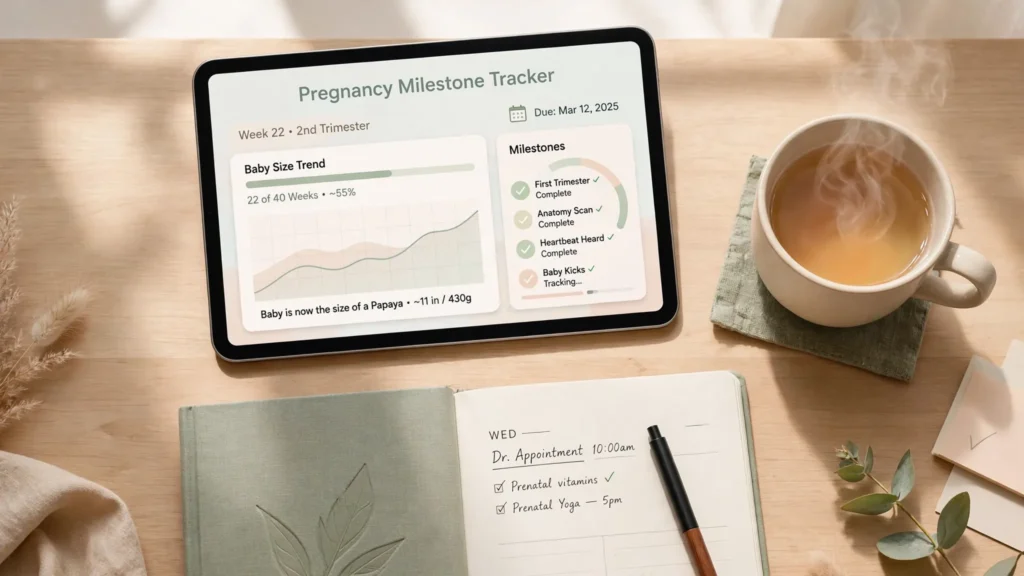
A pregnancy tracker can help you organize important information, but it should complement not replace your prenatal care.
You might track:
Pregnancy milestones
Record important moments such as your first positive pregnancy test, first appointment, scans, first movements, and other meaningful experiences.
Appointments
Keep track of upcoming prenatal visits and questions you want to ask.
Symptoms
A simple record can help you notice changes and communicate clearly with your healthcare team.
Emotional wellbeing
Write down how you have been feeling emotionally.
Personal memories
Record photographs, journal entries, meaningful songs, messages to your baby, or other memories.
Questions
Keep a running list of questions instead of trying to remember everything during an appointment.
Pregnancy Week by Week Should Be a Guide, Not a Checklist
One of the most important things to remember is that pregnancy does not follow an identical script for everyone.
You may read that a certain symptom is common at a particular week and never experience it.
You may also experience something earlier or later than a pregnancy guide describes.
That does not automatically mean something is wrong.
Week-by-week guides are useful for understanding general patterns, but your healthcare professional is the appropriate person to interpret your individual symptoms, test results, measurements, and pregnancy history.
How Womb Serenade Can Support Your Pregnancy Journey
Pregnancy is not only a sequence of medical appointments and developmental milestones.
It is also a personal experience filled with emotions, questions, anticipation, reflection, and moments of connection.
Womb Serenade can become part of that experience by giving expectant mothers a dedicated space for audio, pregnancy information, milestones, and intentional moments throughout the journey.
For example, you might use it to:
- Listen to calming audio during a quiet break
- Create a pregnancy music routine
- Reflect on weekly milestones
- Incorporate music into prenatal bonding
- Explore pregnancy-related educational resources
- Create moments of relaxation during a busy week
The goal is not to replace your healthcare team.
Instead, Womb Serenade can complement prenatal care by helping make everyday pregnancy moments feel more intentional and connected.
Creating Your Own Weekly Pregnancy Routine
You do not need to completely redesign your life every week.
Instead, choose a few simple habits that can travel with you throughout pregnancy.
Once a week
Take a few minutes to ask:
How am I feeling physically?
How am I feeling emotionally?
What has changed this week?
Do I have any questions for my healthcare professional?
What is one thing I can do to care for myself this week?
What is one pregnancy moment I want to remember?
This simple check-in can help you stay connected with your pregnancy without becoming overwhelmed by information.
When Should You Contact Your Healthcare Professional?
A pregnancy guide cannot tell you whether a specific symptom is normal for your individual situation.
Contact your healthcare professional if you are concerned about a symptom, notice a significant change, or simply feel that something is not right.
Depending on your stage of pregnancy and circumstances, urgent symptoms can include heavy bleeding, severe abdominal pain, severe headache or vision changes, difficulty breathing, chest pain, loss or significant change in fetal movement after movements have become established, or signs of labor before you expect it.
Do not rely on a general pregnancy article to determine whether an urgent symptom is safe to ignore.
If something concerns you, seek professional medical advice promptly.
Frequently Asked Questions About Pregnancy Week by Week
How many weeks is pregnancy?
Pregnancy is commonly described as lasting around 40 weeks when counted from the first day of the last menstrual period. The exact timing of birth varies, and your estimated due date is an estimate rather than a guaranteed delivery date.
When does the first trimester end?
Many pregnancy guides consider weeks 1–12 the first trimester, with the second trimester beginning around week 13. The NHS uses weeks 4–12 for its first-trimester week-by-week guide.
When does the second trimester start?
The second trimester is commonly described as beginning around week 13 and continuing through week 27.
When does the third trimester start?
The third trimester commonly begins around week 28. The week-by-week guide covers weeks 28 to 41 as the final trimester.
When can I feel my baby move?
Many people begin noticing fetal movement during the second trimester, but timing varies. If you have questions or concerns about your baby’s movements, contact your healthcare professional rather than comparing your experience with another person’s.
Is every pregnancy week supposed to feel the same?
No. Pregnancy symptoms and experiences vary from person to person and can also vary from one pregnancy to another.
How can I keep track of my pregnancy?
You can use a pregnancy app, calendar, journal, or notebook to record appointments, milestones, questions, symptoms, and memories. A digital pregnancy companion such as Womb Serenade can also help bring some of these everyday pregnancy experiences together.
Can I use a pregnancy app instead of seeing my doctor?
No. Pregnancy apps and educational resources can help you organize information and learn about pregnancy, but they should complement rather than replace prenatal care from qualified healthcare professionals.
Final Thoughts
Pregnancy week by week is a journey of continuous change.
From the earliest weeks of pregnancy to the final preparations for birth, your body, your baby, and your daily life are continually evolving.
You may have weeks filled with excitement, weeks filled with questions, and weeks when your biggest achievement is simply getting through the day.
All of those experiences can be part of pregnancy.
Use week-by-week information to understand the general journey, prepare questions, recognize common changes, and find ideas for supporting your wellbeing.
But remember that your pregnancy does not have to look exactly like someone else’s.
Your healthcare team can help you understand what is happening in your individual pregnancy, while supportive routines such as relaxation, music, journaling, prenatal bonding, and pregnancy tracking can help you stay connected to the experience.
Womb Serenade can be one part of that journey a pregnancy companion designed to bring together audio, reflection, pregnancy milestones, education, and meaningful moments throughout pregnancy.
Your pregnancy is more than a countdown to a due date.
It is a journey, one week at a time.

Pingback: Pregnancy Apps: Features to Look for in a Pregnancy Companion - Womb Serenade