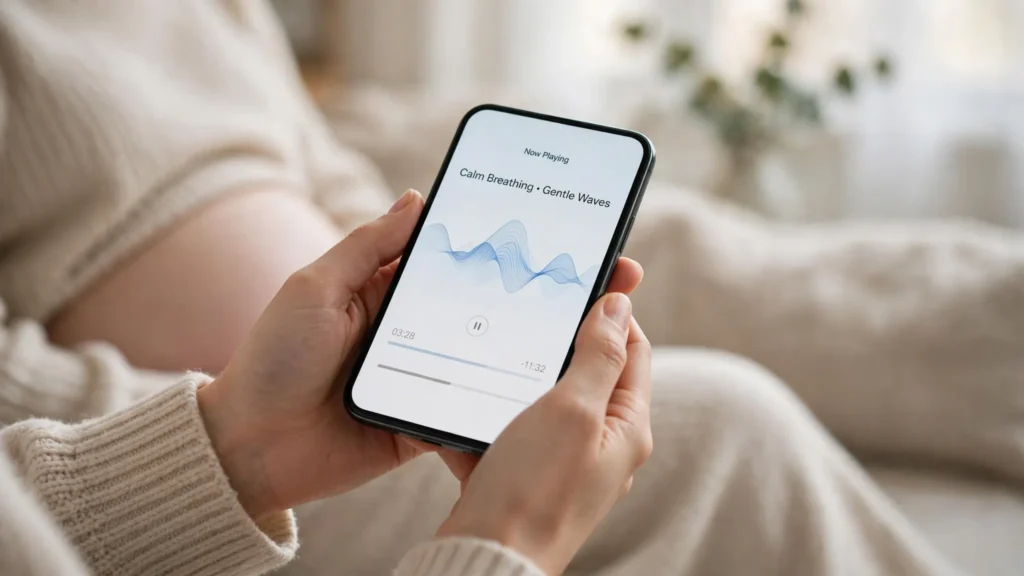
Music is part of everyday life for many people. During pregnancy, it can take on an additional meaning.
A favorite song might become part of your morning routine. Gentle instrumental music might accompany a quiet evening. A meaningful playlist may become something you share with your partner or associate with the months leading up to your baby’s arrival.
For some expectant mothers, pregnancy music also becomes part of relaxation, mindfulness, prenatal bonding, or simply taking a few minutes away from a busy day.

Research has explored music-based interventions during pregnancy, particularly in relation to maternal anxiety and wellbeing. Reviews of randomized studies suggest that music interventions may help reduce anxiety during pregnancy, although results vary between studies and researchers continue to investigate which approaches are most useful.
At the same time, pregnancy music is sometimes surrounded by exaggerated claims. You may have heard that classical music can make an unborn baby smarter or that certain sounds can directly improve fetal development.
These claims require much more caution.
You don’t need a special playlist to give your baby a healthy start, and there is no single type of music every expectant mother should listen to.
Instead, music can be approached as something simpler: an enjoyable tool for relaxation, reflection, connection, and everyday pregnancy wellness.
This guide explores the potential benefits of pregnancy music, how to use it, what types of music you might choose, important safety considerations, and how to create a listening routine that works for you.
What Is Pregnancy Music?
Pregnancy music is a broad term for music or audio that an expectant mother listens to during pregnancy.
It doesn’t have to be specially composed prenatal music.
It could include:
- Classical music
- Instrumental music
- Acoustic songs
- Soft pop
- Jazz
- R&B
- Gospel or worship music
- Afrobeats
- Lullabies
- Ambient music
- Meditation audio
- Nature sounds
- Your favorite songs
Some people use pregnancy music specifically for relaxation.
Others incorporate it into prenatal bonding.
Some listen while journaling, meditating, reading, or preparing for bed.
And many simply continue enjoying the same music they loved before becoming pregnant.
There isn’t one correct way to use music during pregnancy.
Why Do Expectant Mothers Listen to Music During Pregnancy?
There are many reasons.
Some expectant mothers use music to create a peaceful atmosphere after a busy day.
Others use it as part of a self-care or relaxation routine.
Music can also become part of:
- Prenatal bonding
- Mindfulness
- Bedtime routines
- Journaling
- Meditation
- Partner bonding
- Pregnancy reflection
- Quiet breaks
- Everyday entertainment
The important point is that music doesn’t need to accomplish a medical or developmental goal to be valuable.
Enjoying it can be enough.
Potential Benefits of Music During Pregnancy
Research into music interventions during pregnancy has produced some encouraging findings, particularly around maternal anxiety.
A systematic review and meta-analysis of 11 randomized controlled trials involving 1,482 pregnant women found that music interventions were associated with reductions in anxiety, including benefits from listening to music at home.
Other reviews have also reported potential reductions in maternal anxiety, although study quality and methods vary.
This means pregnancy music should be viewed as a potentially useful supportive wellness activity, rather than a guaranteed treatment.
Here are some of the ways it may fit into your pregnancy.
1. Creating Moments of Relaxation
One of the simplest uses of music during pregnancy is creating an environment where you can slow down.
You might listen while:
- Resting after work
- Sitting comfortably at home
- Taking a quiet afternoon break
- Reading
- Journaling
- Preparing for bed
Music can provide a transition between a busy part of your day and a quieter moment.
You don’t need a long session.
Even one or two songs can become a simple pause in your routine.
If relaxation is your main goal, explore our guide to calming music during pregnancy for ideas on creating peaceful listening moments.
2. Supporting a Pregnancy Wellness Routine
Pregnancy wellness doesn’t have to involve complicated routines.
Your routine might simply include:
- Drinking water
- Resting when possible
- Gentle movement when appropriate
- Eating nourishing meals
- Attending prenatal appointments
- Taking a few quiet moments
- Listening to music you enjoy
Music can become one small part of that larger picture.
For example, you might create a 10-minute evening routine involving comfortable breathing, music, and reflection.
The goal isn’t to create another task you must complete.
It is to create something you look forward to.
3. Providing a Tool for Mindfulness
Mindfulness involves bringing your attention to the present moment rather than constantly thinking about what happened earlier or what might happen next.
Music can give your attention something simple to focus on.
You might notice:
- The melody
- Individual instruments
- The rhythm
- Your breathing
- How the music makes you feel
If your mind wanders, simply bring your attention back to the sound.
You don’t need previous meditation experience to try this.
4. Creating Opportunities for Prenatal Bonding
Music can also become part of prenatal bonding.
You might sit somewhere comfortable, play a meaningful song, and spend a few minutes thinking about your baby.
You could also:
- Talk to your baby
- Sing
- Read aloud
- Place your hands comfortably on your bump
- Write in a pregnancy journal
- Invite your partner to participate
The activity doesn’t need to be elaborate.
If you want more ideas, our guide on how to bond with your baby during pregnancy explores several simple ways to create intentional moments of connection.
It is also important to remember that prenatal bonding feels different for everyone.
Some parents experience a strong emotional connection early in pregnancy. For others, that feeling develops gradually.
You don’t need to force it.
5. Creating Meaningful Pregnancy Memories
Music has a powerful relationship with memory.
A song you listen to repeatedly during pregnancy may eventually remind you of:
- Preparing your baby’s room
- Feeling your baby move
- Quiet evenings at home
- Conversations with your partner
- Anticipating your baby’s arrival
Some parents create a pregnancy playlist containing songs they hope to continue enjoying after their baby is born.
You might include:
- Your favorite songs
- Songs from your relationship
- Family favorites
- Lullabies
- Meaningful spiritual music
- Songs chosen specifically for your baby
The playlist can become a personal record of your pregnancy experience.
6. Supporting an Evening Wind-Down Routine
Music can also fit naturally into your bedtime routine.
For example:
- Reduce bright screens.
- Find a comfortable position.
- Play a gentle track.
- Take a few comfortable breaths.
- Read or journal.
- Allow yourself to transition toward rest.
You don’t have to fall asleep while listening.
The music can simply signal that the busy part of your day is ending.
7. Creating Shared Moments With Your Partner
Pregnancy music doesn’t have to be something you experience alone.
Your partner can participate too.
You could:
- Build a playlist together
- Choose songs for your baby
- Listen together before bed
- Talk to your baby
- Sing together
- Share songs from your childhoods
- Discuss memories connected to particular music
These simple activities can create shared moments during pregnancy.
Can Babies Hear Music in the Womb?
As pregnancy progresses, fetal hearing develops.
The CDC notes that fetal ears are developed by around the 20th week of pregnancy and that fetuses begin responding to sounds around the 24th week.
That doesn’t mean your baby hears music exactly as you do.
Sound travels through your body and the surrounding tissues before reaching the fetus.
It also doesn’t mean that you need to turn the volume up.
Normal listening is enough.
There is no need to try to make music louder specifically for your baby.
Is It Safe to Listen to Music During Pregnancy?
For ordinary everyday listening at a comfortable volume, music is generally something expectant mothers can continue enjoying.
The more important concern is very loud noise exposure.
The CDC states that very loud noise during pregnancy may be capable of damaging a developing fetus’s hearing. It recommends reducing exposure to hazardous noise and specifically advises pregnant workers to avoid extremely loud environments.
This distinction matters.
Listening to gentle music in your bedroom is very different from spending several hours beside powerful speakers at a concert or working around loud industrial machinery.
For a more detailed explanation, read our guide: Is It Safe to Listen to Music During Pregnancy?
How Loud Should Pregnancy Music Be?
You don’t need high volume.
Keep your music at a level that feels comfortable.
For everyday listening:
- Avoid unnecessarily high volume.
- Move away from extremely loud speakers.
- Take breaks from prolonged loud sound.
- Lower headphone volume when possible.
- Choose quieter environments rather than increasing volume to overcome background noise.
The CDC considers occupational noise at or above 85 dBA hazardous to adult hearing and advises pregnant people to avoid extremely loud noise exposure.
You don’t need to measure every song with a decibel meter.
The practical goal is simply to avoid excessive noise.
Should You Put Headphones on Your Belly?
There is no need to place headphones directly against your abdomen.
If you want to listen to music during pregnancy, wear headphones normally or play music through speakers at a comfortable level.
Making the sound louder or positioning speakers directly against your bump is not necessary.
Pregnancy music should primarily be an enjoyable experience for you.
What Is the Best Music to Listen to During Pregnancy?
There isn’t one universally best genre.
Your personal preferences matter.
Here are some options you might explore.
Classical Music
Classical music can work well if you enjoy instrumental compositions and slower pieces.
But you don’t need to listen to Mozart simply because you’re pregnant.
Instrumental Music
Instrumental tracks can be useful during relaxation, reading, journaling, or mindfulness because there are no lyrics competing for your attention.
Acoustic Music
Soft guitar, piano, and acoustic vocals can create a warm and intimate atmosphere.
Ambient Music
Ambient music can provide gentle background sound during rest or reflection.
Nature Sounds
Rain, waves, forests, streams, and similar sounds may appeal to people who prefer natural soundscapes.
Lullabies
Some parents enjoy choosing lullabies they may eventually sing to their babies.
Worship or Spiritual Music
If spiritual music is meaningful to you, it can naturally become part of prayer, gratitude, or reflection during pregnancy.
Your Favorite Music
Your existing music library is also perfectly valid.
Pregnancy doesn’t mean you suddenly have to listen exclusively to piano music.
You can still enjoy:
- Afrobeats
- R&B
- Pop
- Gospel
- Jazz
- Country
- Rock
- Hip-hop
- Other genres you love
If you want help building your playlist, explore our guide to the best types of music to listen to during pregnancy.
Is Classical Music Better for Your Baby?
This is one of the biggest myths surrounding pregnancy music.
The idea that listening to classical music particularly Mozart will automatically make your baby more intelligent is not something expectant parents should treat as established medical fact.
You can certainly listen to classical music.
But listen because:
- You enjoy it.
- You find it relaxing.
- You like the compositions.
- It fits your routine.
Don’t feel obligated to listen because you believe your baby’s future intelligence depends on it.
It doesn’t.
Does Pregnancy Music Improve Fetal Development?
This is another area where claims should be approached carefully.
Research has investigated fetal responses to sound and music, but evidence does not justify promising that prenatal music will improve intelligence or guarantee developmental advantages.
A systematic review and meta-analysis examining prenatal music therapy found no significant changes in fetal heart rate, fetal movements, or accelerations compared with no music therapy.
That doesn’t make pregnancy music useless.
It simply means its value should not be exaggerated.
There are plenty of reasons to enjoy music without promising that it will transform fetal development.
Can Music Reduce Anxiety During Pregnancy?
This is one area where research is more encouraging.
Several systematic reviews have found evidence that music-based interventions may reduce maternal anxiety during pregnancy.
For example, one meta-analysis involving 11 randomized controlled trials found an overall reduction in anxiety among pregnant women receiving music interventions.
Another review found reductions in anxiety but noted that the included studies had methodological limitations.
More recent systematic reviews have also reported generally positive findings for maternal anxiety, while emphasizing differences in study design and the need for stronger research.
So a reasonable conclusion is:
Music may be a useful addition to a relaxation or wellness routine for some pregnant women, but it should not replace professional support for significant anxiety.
If anxiety is persistent, overwhelming, interfering with daily life, or causing significant distress, talk with your doctor, midwife, or another qualified healthcare professional.
Pregnancy Music vs. Music Therapy
These terms are sometimes used interchangeably online, but they aren’t necessarily the same thing.
Pregnancy Music
This can simply mean listening to music during pregnancy for enjoyment, relaxation, bonding, or routine.
Music Therapy
Music therapy is a more structured therapeutic approach that may involve a trained professional and specific therapeutic goals.
Listening to your favorite playlist at home can be valuable, but it shouldn’t automatically be described as professional music therapy.
Understanding the difference helps prevent ordinary wellness activities from being presented as medical treatments.
How to Create a Pregnancy Music Routine
You don’t need an elaborate schedule.
Start with something simple.
Step 1: Choose a Time
Find a part of your day when you’re likely to have a few quiet minutes.
This might be:
- Morning
- Lunch break
- After work
- Early evening
- Before bed
Step 2: Choose Your Music
Start with two or three songs you enjoy.
You can expand your playlist later.
Step 3: Find a Comfortable Space
Sit or rest somewhere comfortable and reduce unnecessary distractions.
Step 4: Keep the Volume Comfortable
There’s no benefit to making the music excessively loud.
Step 5: Listen Intentionally
Instead of scrolling through your phone while the music plays, give yourself a few minutes to actually listen.
Step 6: Add Another Activity If You Want
You might combine music with:
- Comfortable breathing
- Journaling
- Reading
- Prenatal bonding
- Reflection
- Mindfulness
If you want a complete step-by-step routine, read our guide on how to create a relaxing pregnancy music routine.
A Simple 10-Minute Pregnancy Music Routine
Here’s an easy routine you can try.
Minute 1: Get Comfortable
Sit somewhere comfortable and reduce distractions.
Minutes 2–3: Slow Down
Take a few comfortable breaths.
Allow yourself to transition away from whatever you were doing.
Minutes 4–7: Listen
Play one or two songs.
Focus on the music instead of multitasking.
Minutes 8–9: Connect or Reflect
You could:
- Think about your baby
- Talk quietly
- Place your hands comfortably on your bump
- Reflect on your day
- Think about something you’re grateful for
Minute 10: Finish
Take a moment before returning to the rest of your day.
That’s it.
You don’t need an hour-long routine to create a meaningful listening experience.
How Often Should You Listen to Music During Pregnancy?
There is no required schedule.
You don’t need to listen:
- Every day
- For a certain number of minutes
- At a particular trimester
- At a particular time of day
Listen when it works for you.
You might enjoy music every evening.
Or perhaps only occasionally.
Pregnancy music should support your experience rather than become another rule you feel pressured to follow.
Can You Use Pregnancy Music for Prenatal Bonding?
Yes, if you enjoy doing so.
A simple bonding routine could look like this:
- Choose a meaningful song.
- Find somewhere comfortable.
- Listen for a few minutes.
- Talk or sing to your baby if you want.
- Reflect on your pregnancy.
You could also invite your partner to join you.
For additional ideas, explore ways to feel more connected to your baby before birth or our guide to creating a daily prenatal bonding routine.
What About Pregnancy Music Apps?
A pregnancy music app can be useful if you want audio organized specifically around pregnancy.
Some apps focus entirely on music.
Others combine audio with:
- Pregnancy tracking
- Milestones
- Education
- Relaxation
- Prenatal bonding
- Wellness resources
Before choosing an app, consider:
- Audio quality
- Ease of use
- Privacy
- Content quality
- Playback controls
- Variety
- Evidence behind health claims
- Whether it fits your actual needs
Our guide to pregnancy music apps and what to look for in a prenatal audio experience explores these considerations in more detail.
Using Womb Serenade as Part of Your Pregnancy Music Routine
For expectant mothers who want more than a general music playlist, Womb Serenade is designed around a broader pregnancy experience.
Rather than treating audio as an isolated feature, Womb Serenade brings pregnancy-focused audio together with elements of wellness, learning, milestones, and prenatal connection.
For example, you might use Womb Serenade to create a quiet listening moment, incorporate audio into your prenatal bonding routine, explore pregnancy information, or follow milestones throughout your pregnancy.
This reflects a simple idea:
Pregnancy support doesn’t always have to feel clinical.
Sometimes you may want information.
Sometimes you may want reassurance.
And sometimes you may simply want a quiet moment.
Womb Serenade is designed to bring those different parts of the pregnancy experience into one supportive environment.
It should complement not replace professional prenatal care.
Common Pregnancy Music Myths
Myth 1: Classical Music Makes Babies Smarter
There is no good reason to promise that listening to classical music during pregnancy will make your baby more intelligent.
Enjoy classical music if you like it, not because you feel obligated to improve your baby’s IQ.
Myth 2: You Have to Play Music Directly to Your Belly
You don’t.
Normal listening is enough.
Myth 3: Louder Music Is Better for the Baby
No.
There is no benefit to unnecessarily increasing sound exposure, and very loud noise during pregnancy can be a concern.
Myth 4: Pregnancy Music Must Be Slow
No.
You can enjoy energetic music too.
If Afrobeats, pop, gospel, R&B, jazz, or another genre makes you happy, you don’t have to stop listening because you’re pregnant.
Myth 5: You Need to Listen Every Day
There is no required pregnancy music schedule.
Myth 6: Pregnancy Music Replaces Stress or Anxiety Treatment
It does not.
Music can be a supportive relaxation tool, but significant or persistent anxiety deserves appropriate professional care.
Tips for Making Pregnancy Music More Enjoyable
Choose Music You Actually Like
Don’t build your playlist entirely around someone else’s recommendations.
Create Smaller Playlists
You could have separate playlists for:
- Morning
- Relaxation
- Prenatal bonding
- Evening
- Bedtime
Include Meaningful Songs
Add songs connected to positive memories, relationships, family, or important moments.
Let Your Partner Contribute
Ask your partner to choose a few songs.
Keep the Routine Flexible
If you’re tired, skip it.
If you want upbeat music instead of relaxing music, change the playlist.
Don’t Chase Perfect Results
You don’t have to feel instantly relaxed every time you press play.
Some days music will be exactly what you need.
Other days it won’t.
That’s normal.
Frequently Asked Questions
Is music good during pregnancy?
Music can be an enjoyable part of pregnancy and may support relaxation and maternal wellbeing. Research suggests that some music interventions may reduce anxiety during pregnancy, although effects vary and music shouldn’t be treated as a replacement for medical or mental health care.
Is it safe to listen to music during pregnancy?
Ordinary music listening at a comfortable volume is generally something expectant mothers can continue enjoying. The greater concern is prolonged exposure to very loud noise.
What music is best during pregnancy?
There is no universally best genre. Classical, instrumental, acoustic, ambient, nature sounds, spiritual music, lullabies, and your personal favorites can all be appropriate choices.
Can my baby hear music in the womb?
Fetal hearing develops during pregnancy. The CDC notes that fetal ears develop by around week 20 and responses to sound begin around week 24.
Does music make babies smarter?
There isn’t sufficient evidence to claim that listening to a particular type of music during pregnancy will make a baby more intelligent.
Can music help with pregnancy anxiety?
Research suggests music interventions may reduce anxiety for some pregnant women. However, persistent or significant anxiety should be discussed with a qualified healthcare professional.
Can I listen to music every day while pregnant?
Yes, if you enjoy it. There is no required listening schedule, and you should keep the volume comfortable.
Can I use headphones during pregnancy?
Yes. Wear headphones normally and keep the volume comfortable. There is no need to place headphones directly against your abdomen.
How long should I listen to pregnancy music?
There is no required duration. You might listen for five minutes, twenty minutes, or simply enjoy music throughout your normal day.
Can my partner join my pregnancy music routine?
Yes. Creating playlists, listening together, singing, talking to your baby, and choosing meaningful songs can become shared pregnancy activities.
Do I need a pregnancy music app?
Not necessarily. A standard music service may be enough if you simply want music. A pregnancy-focused app may be useful if you want audio integrated with prenatal bonding, pregnancy education, wellness, milestones, or other pregnancy-specific resources.
Final Thoughts
Pregnancy music doesn’t need to be complicated.
You don’t need a scientifically engineered playlist.
You don’t need to listen to Mozart every morning.
You don’t need to put headphones against your belly.
And you don’t need to listen for a certain number of minutes every day.
Music can simply become one enjoyable part of your pregnancy.
It can create a quiet moment after a busy day.
It can accompany a bedtime routine.
It can give you something to focus on during mindfulness.
It can become part of prenatal bonding.
It can create memories with your partner.
Or it can simply make you happy.
Research suggests that music-based interventions may have benefits for maternal anxiety and wellbeing, but evidence does not support turning pregnancy music into promises about intelligence or guaranteed fetal development.
A healthier approach is much simpler:
Choose music you enjoy. Keep the volume comfortable. Create moments that feel meaningful to you.
And if you want pregnancy-focused audio to sit alongside learning, milestones, wellness, and prenatal connection, Womb Serenade is designed to bring those experiences together as part of a broader pregnancy companion.